I didn’t stay long in Tashkent, which seems a shame, but appears to be typical. The city bookended my visit – it’s where most travelers arrive and depart and see perhaps a day’s worth of main sights before heading off to Samarkand, Bukhara, and perhaps beyond. But I liked Tashkent as a city and enjoyed my “official” day-long private tour with an excellent guide. I also liked having almost two full days on my own to roam around.
A note about spellings There are different systems of “romanizing” languages written in non-latin alphabets and scripts, that is, converting sounds of the source language to generally equivalent latin-alphabet sounds. So, if you research places and names, you’re likely to find various spellings. I’ve made spelling choices from looking at English language materials and web sites. Non-English latin-alphabet materials will likely show yet more options, as does my French guidebook (petit futé Ouzbékistan). I hope my spellings work for you.
The “official” tour – seeing the highlights
After my swift departure to the Fergana Valley, I returned to Tashkent to meet my guide and see the sights. While Tashkent is one of Central Asia’s oldest cities, it’s also one of the most modern; it was nearly destroyed by a 1966 earthquake, was rebuilt by the Soviets, and continues to develop. In short, there’s not a lot of old Tashkent left. The Hazrati Imam Mosque Complex in the old city, and some of the adjacent neighborhoods, including the Chorsu Bazaar, are the best places to get an impression of old Tashkent.
Hazrati Imam Mosque Complex
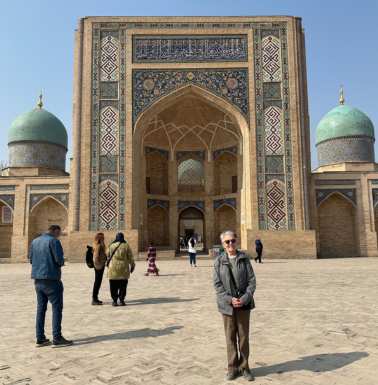
Historic buildings and sites surround a big central plaza at the complex. The Barak Khan Madrasah dates from the 16th century and saw significant restoration following the 1966 earthquake. The former student rooms now house artisan shops. I regret not buying a beautiful suzani (hand embroidered silk fabric) jacket made by hand at a mother-daughter atelier, but I did leave with a classic Uzbek miniature painting on Samarkand paper – my contemplative man has traditional melons at his feet and a bird in a cage. The artist also paints beautiful birds and flowers which, he says, are popular with tourists.
Barak Khan Madrassah Tashkent
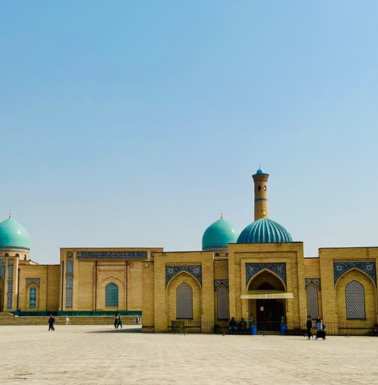
Across the plaza, a modern mosque and the small building on the right is the Muyi Mubarak Madrassah where the Osman Quran is kept.
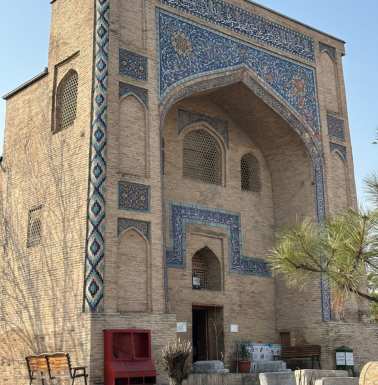
Mausoleum of 10th century Islamic scholar and poet Abubakr Kaffal ash-Shashi
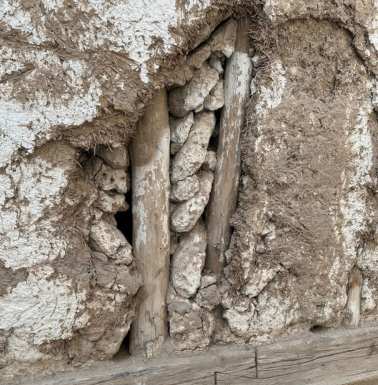
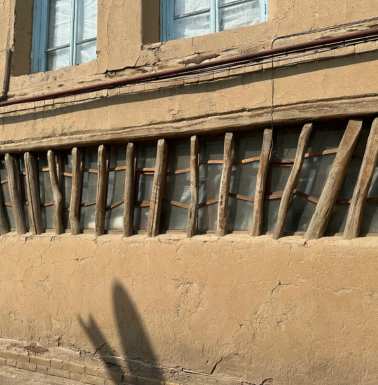
Old Tashkent Building with mud, straw, sticks and stones was helpful against earthquakes to a point.
More old building techniques.
The Mahallah tea house (and adjacent canal) under reconstruction.
Also in the complex, the Muyi Mubarak Madrasah houses, among its rare manuscripts and books, one of the world’s earliest copies of the Quran. Written in Hejazi script on deerskin before the year 1,000, the enormous volume (about one-third of the original) is kept secure in a glass case. Photographs are forbidden although websites such as IslamiCity have pictures. Regardless of your faith background, it’s a hypnotic sight.
The 16th century mausoleum of 10th century Islamic scholar and poet Abubakr Kaffal ash-Shashi is one of the most significant sites in the complex, a place of pilgrimage and prayer. My guide and I entered, appropriately with headscarves and without shoes, but a man looked our way with what seemed like resentment, the one and only time I experienced that. I whispered concerns to my guide, she said we were fine, and we stayed for her to show me the tombs without any trouble.
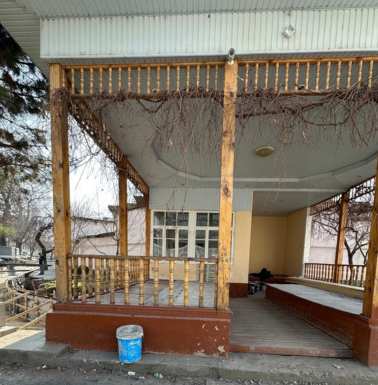
The narrow labyrinthine streets of the old neighborhood (mahallah) around the complex along with its tea house and canal (both of the latter being rehabilitated) is where to get more of an impression of the past. As we walked along usually featureless walls, sometimes past closed, carved double doors that likely open onto courtyards, my guide explained how the narrow streets remain in shadow during the hot summers and described building techniques for cooling and for some measure of earthquake protection, as well as the old mahallah’s robust cultural life. We stood talking in front of the historic neighborhood tea house while across the little square several grannies tended to babies. Soon large numbers of men began to assemble for Friday prayer in the huge mosque complex plaza, and we made our way out of the mahallah against this current to find our driver Ikram.
Chorsu Bazaar
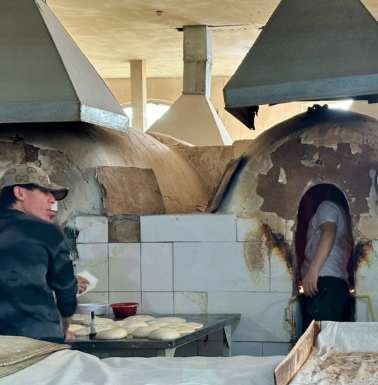
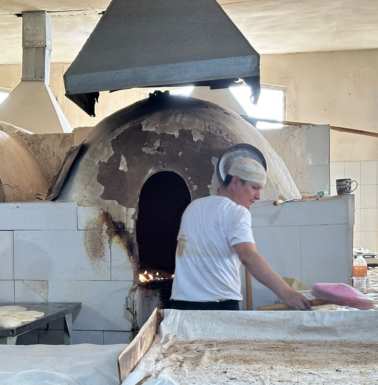
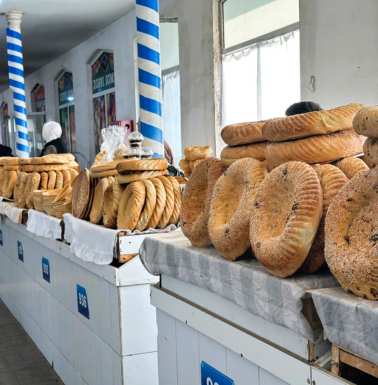
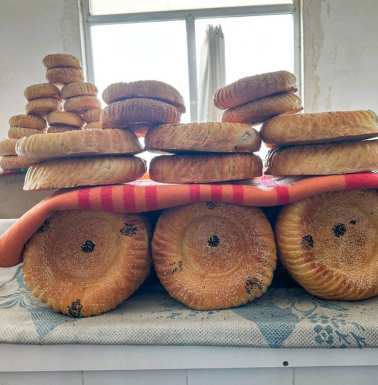
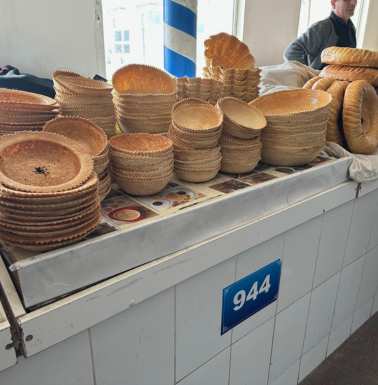
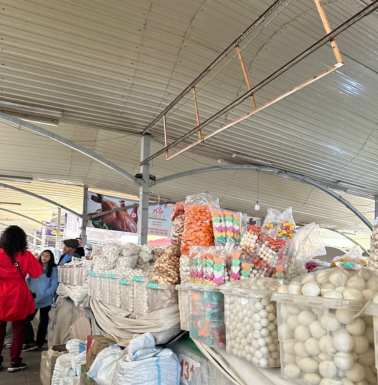
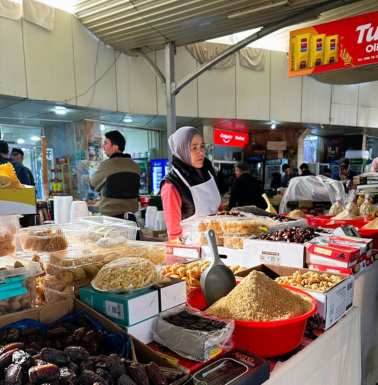
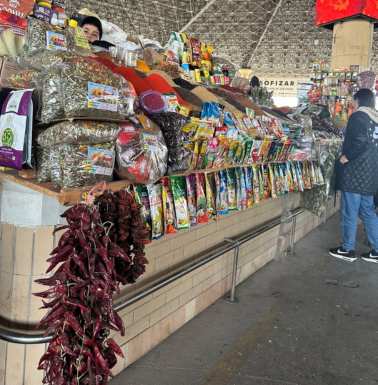
The old city’s Chorsu Bazaar has ancient roots but sits under a colossal Soviet-era, turquoise dome that I thought should cover a grand aquatic center; but the turquoise tiles mirror the symbolic color of Islamic domes instead, and as for the dome’s size, well, the bazaar is just huge. There are handicrafts and household items here but mainly, acres and acres, hectares and hectares, of foods. Busy, colorful, and aromatic with the scents of spices and baking bread. I could hardly get enough of Chorsu, even though all I bought was bread, just from the oven, which I ate pinch by pinch before I got back to my hotel. I tasted everything that my guide suggested, though.
Bread going in the oven.
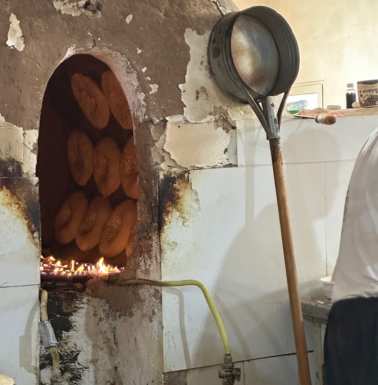
Bread baking on oven walls.
Fresh bread coming out.
One - and only one - array of bread for sale.
More bread!
Eat your bowl with its contents.
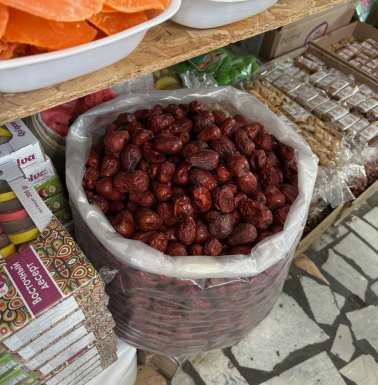
Dried fruits, sugared and not.
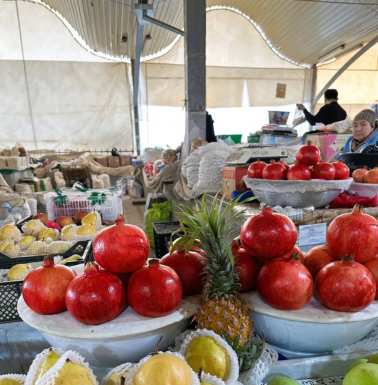
The pomegranate is a powerful national symbol in Uzbekistan.
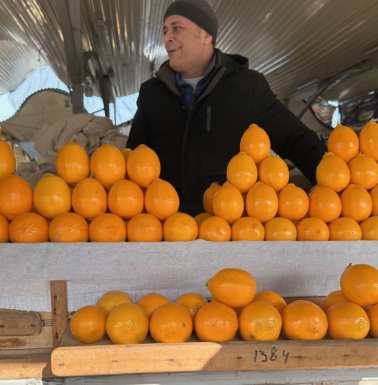
I think these are lemons.
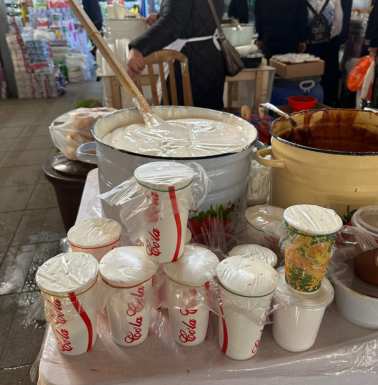
Nisholda is a sweet made especially for Ramadan. I thought it tasted like marshmallows.
Sweets, and qurut (kurt), or dried yogurt balls, which I found salty and a little bitter.
This vendor has dried fruit, nuts, spices, and too many products to detail!
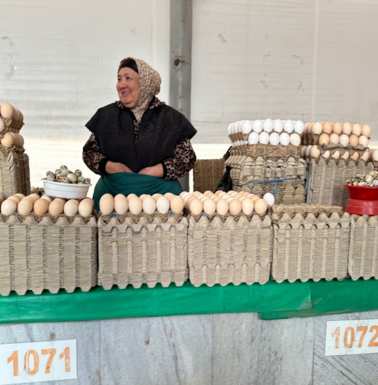
My favorite egg vendor.
Romanov Palace
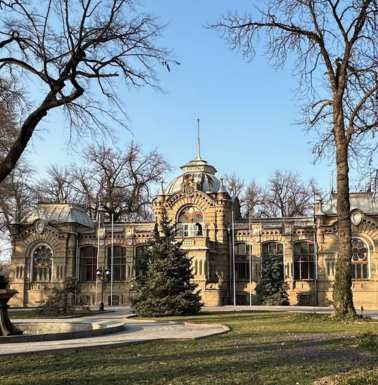
The Palace of Russian Grand Duke Nicholas Konstantinovich Romanov, cousin of ill-fated Tsar Nicholas II, was on my personal list of sites along with tourist highlights, but I wasn’t even able to get onto the grounds at the end of my city tour. It was easy though to see the one-story, 19th century house through the fence, noting all the animal sculptures and motifs – the Grand Duke was a keen hunter. And it was pleasant walking through the soon to be leafy parks around the palace. How did the Grand Duke wind up here? During the period of Russia’s colonization, he was exiled here by the royal family for his various scandals. But once settled in Tashkent, he became something of a model citizen, good contributor to various works and causes, and was well-regarded.
Romanov Palace Tashkent
The Metro
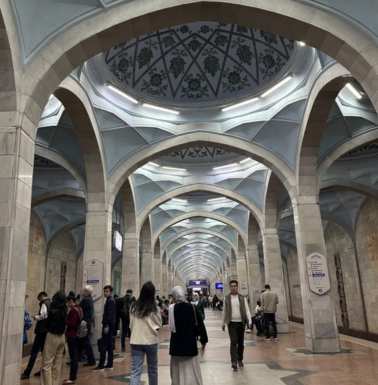
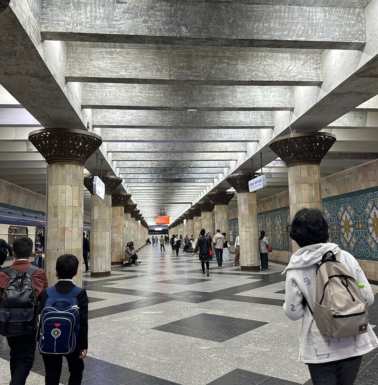
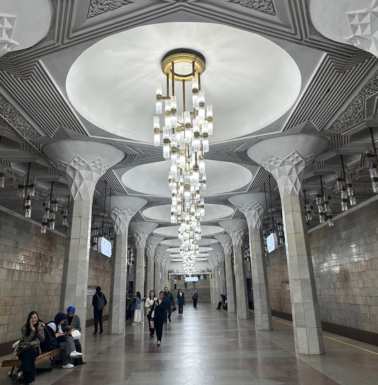
If you’ve seen the Moscow metro, you’ll have an idea what a provincial Soviet-style metro can be. Tashkent’s won’t disappoint. Stations are clean and prettily decorated, and while I was cautioned that the system wasn’t extensive, I found it more than adequate for a visitor. The only thing might be that it was a walk from my hotel to the nearest station.
Tashkent Metro Station
Tashkent Metro
Tashkent Metro
Besides the official tour, what else?
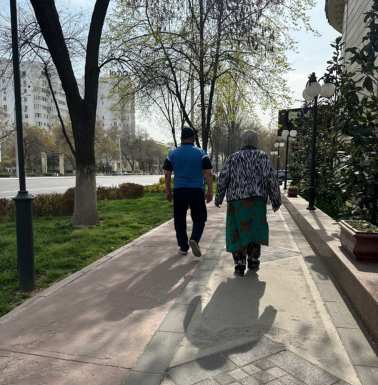
On my free days, I wandered around a lot – much walking with no aim in mind – observing people going about business, kids heading home from school, and the ubiquitous food delivery bikes.
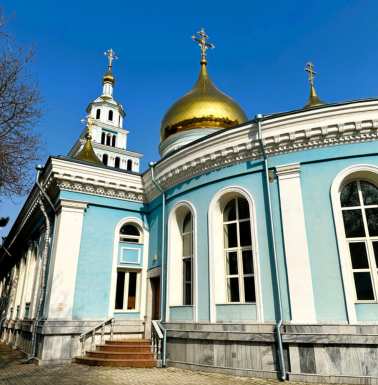
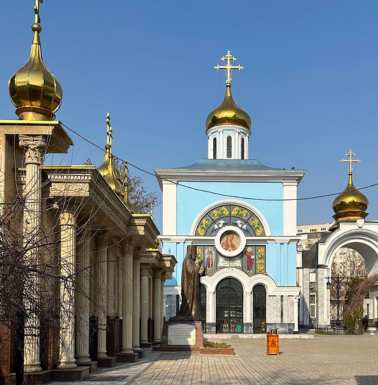
The Holy Assumption Cathedral Church and Russian Orthodox Center, which was of particular interest to me, was an easy walk from my hotel. I also wandered as far as the State Museum of Arts which was temporarily closed. Too bad, because I could have used a rest by the time I got there. Of course, I’d have enjoyed the art, too.
Holy Assumption Russian Cathedral
Russian Orthodox Center grounds.
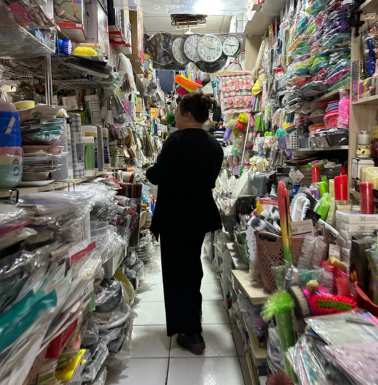
At Vce dlya doma (Everything for the home) in Mirobod Bazaar she knew exactly where to find sink stoppers.
Mirobod Bazaar
And I had to go shopping for a sink stopper, as I’d decided uncharacteristically not to bring one, and even in my nice hotel the lavatory didn’t hold water long enough for hand laundry – the sine qua non of carry-on only travelers. This quest took me into local shops, not tourist stores, and forced me to talk to people as best I could.
After trying innumerable shops around and in my neighborhood Mirabod Bazaar, I hit paydirt at Bce для дома (Everything for the Home) where the vendor went down an aisle in what looked to me like a cacophony of random products and pulled out what I needed. It’s a quirky little stopper that I still have, one of those weird souvenirs that hang around on shadowy cabinet shelves.
Later on, a quiet farewell in Tashkent
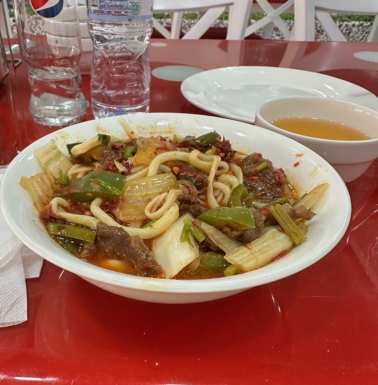
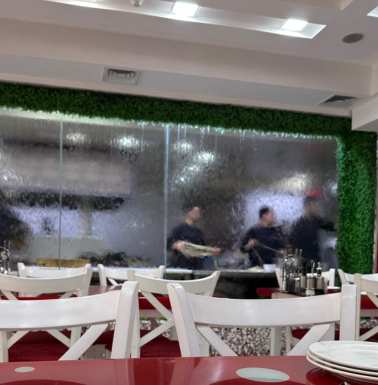
After traveling all the way to Karakalpakstan and flying back to Tashkent from Urgench at the end of my trip, I had my last Tashkent lunch at Anor, a casual family restaurant with inexpensive typical Uzbek food. I’d asked a young man at my hotel about a nearby restaurant, and he replied, “That’s Turkish. Go to Anor. It’s Uzbek.” So, I did and had a farewell bowl of the famous Uzbek lagman, a hearty stew served on hand-pulled noodles, while I watched young men pull the lagman noodles behind a glass waterfall.
And at midnight, my driver Ikram came, and I left for the airport and home.
Farewell lagman at Anor. There are a lot of long, unruly noodles in this dish. I noticed another diner and I were both checking our shirts for splashes.
Pulling lagman noodles behind the glass waterfall.
On my way home
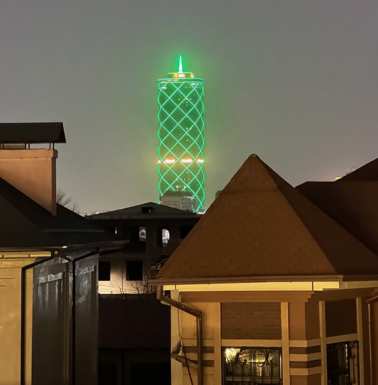
One of my new Tashkent neighbors winked goodbye in changing colors.