Shahrisabz – Over the Mountains from Samarkand
A short account...
We – my guide, driver, and I – made a day trip from Samarkand to see the ruins of Tamerlane’s gargantuan summer palace, Ak-Saray, and the vast mausoleum complex where Tamerlane had planned to be interred, here in his birthplace of Shahrisabz, known then as Kesh. It’s a popular destination, so popular that it’s been partially redone for tourists. More on that later.
Over the Zarafshan range
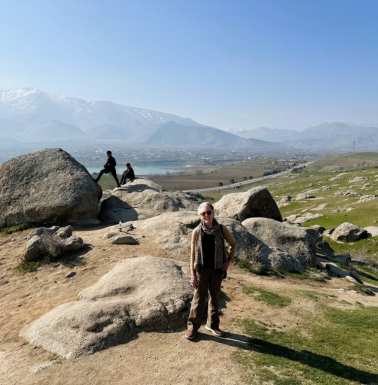
The road there from Samarkand is one of the trip’s attractions. The road out of town is flat, and we saw fruit orchards starting to bloom on both sides (it’s where my driver counseled me to return in the fall when the fruits are ripe). But we soon started climbing and before long stopped at the filming location of the 1970s, Cold War-era East German film “Apachen” (Apaches). The location was chosen for its resemblance to the southwestern US, something the director Gottfried Kolditz saw more than I did. I just don’t have the eye, and I haven’t seen the film. There’s a lot you can do with composition and editing. But I enjoyed the stop, the beautiful view, and the connection with home.
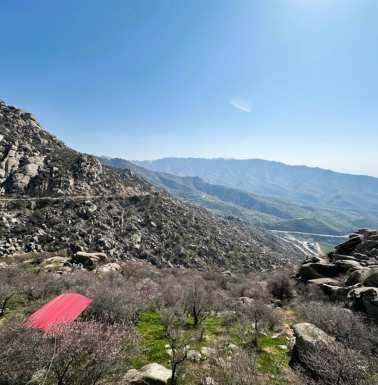
We continued climbing from there to Takhta-Karacha Pass where we crossed over into the valley where Shahrisabz is located. The pass is at 1,650 meters, about 5,400 feet, and from Samarkand, we climbed roughly 1,000 meters or 3,000-3,500 feet. That wouldn’t be especially dramatic except that the road is steep and serpentine with few places to pull over or stop. And there was still snow in places. Because we were in a passenger car, we could travel the “scenic route” – no vehicles larger than certain small vans are allowed on the steep road.
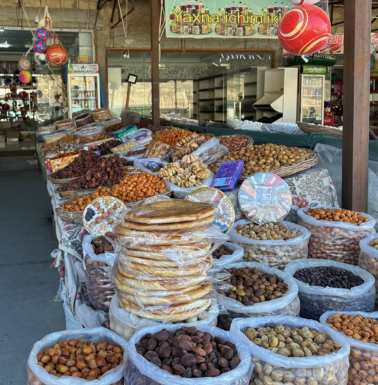
There are markets here and there, but the big market at the Pass is where we first stopped to look at the scenery and where I bought pistachios and some sort of fruit jerky. I recall wishing that I’d bought more of whatever it was. Of course, I head for the dried fruit and nuts, but there was a lot of other merchandise, from cold drinks to qurut – the dried yogurt balls I tried in Tashkent – to footballs (soccer balls) that you would need if you had kids along who had forgotten theirs. Our only other stop was at a nearby pull-out for more of the view.
Shahrisabz – Ak-Saray and the Dor us-Siyadat complex
Perhaps the main attraction at Shahrisabz is the ruined portal of Tamerlane’s Ak-Saray, or White Palace. But the Dor us-Siyadat complex is one of Central Asia’s most important memorial ensembles and deserves equal attention.
⎯Ak-Saray
We know a fair amount about Tamerlane’s buildings thanks to the King of Castile’s ambassador Ruy Gonsalez de Clavijo who stopped here on his way to Samarkand in 1404 and who described the Ak-Saray “doorway” as “very broad and lofty.” As built, the portal was 71 meters (more than 230 feet) high and the vault, 22.5 meters (almost 74 feet) wide. The ruined towers are about 38 and 40 meters (about 125 feet) high.
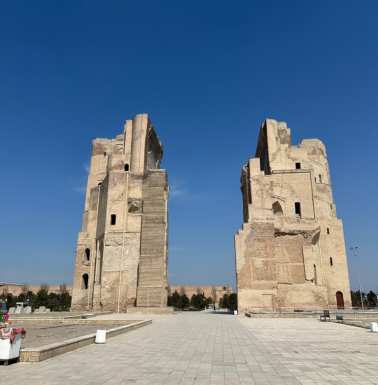
My guide and I entered through a gate in the remaining portion of the old city wall and sat in the shade of one tower where rows of benches can hold wedding guests (I read this is a popular wedding venue) and event spectators. We discussed the history and legends about Ak-Saray construction – there are always legends! My favorite concerns the architect, who was being rushed. He stretched a chain between Ak-Saray’s unfinished portal towers and disappeared. Good idea, that. After some time, the architect reappeared and measured the distance from ground to chain. It was less; the towers had settled enough, and construction carried on. This seems apocryphal, but the towers’ foundations do extend 10 meters into the ground.
As we approached the towers, two young women asked if they could interview me for a school project. My guide translated the request, and of course I agreed, although I warned I would speak English. The questions were few and general, as were my responses about education, goodwill, and community service, but it was a special, unexpected moment for me, and the girls thus completed their assignment.
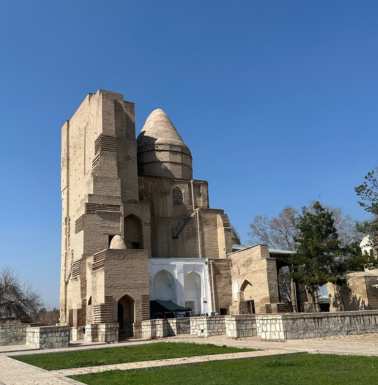
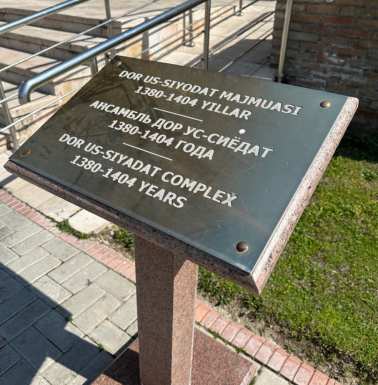
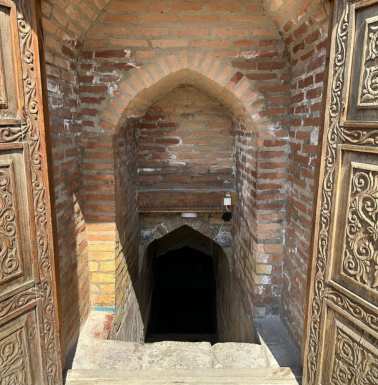
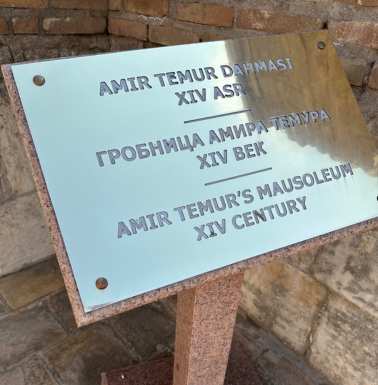
The Dor us-Siyadat memorial complex was started after the untimely death of Tamerlane’s oldest and favorite son, Jahongir. When the second son was killed in battle, he too was buried at the complex. The memorial complex included not only dynastic tombs but a madrasah and a spiritual teaching center. Of course, Tamerlane intended to be buried here himself, but we already know that he wasn’t.
Kok-Gumbaz Mosque
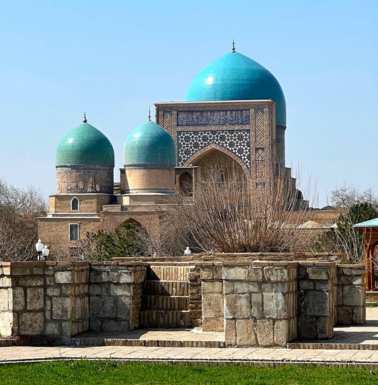
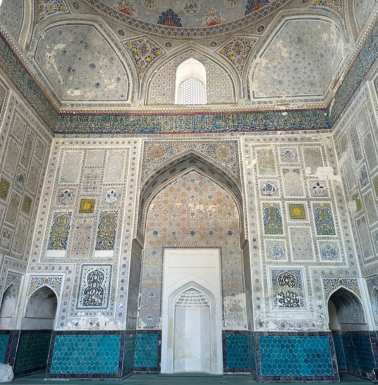
The 15th century Kok-Gumbaz (Blue Dome) was built by Tamerlane’s grandson Ulugh Beg (the scientist / astronomer / ruler) as Shahrisabz’s Jummah Mosque (the Friday congregate mosque). It has been much restored. The original dome which rivaled Bibi-Khanym in size collapsed in the 18th century and the current dome was built in the 20th century, according to an Uzbek travel site.
Destruction in 1570
By 1570, barely a century and a half after Tamerlane’s death, Samarkand was under the khanate of a new power, Abdulla Khan, the ruler of Samarkand and Bukhara, whose forces destroyed most of Shahrisabz’s grand monuments that were symbolic of the Timurid dynasty’s power. Only portions of Ak-Saray remain as we’ve seen, and of the memorial complex only the Jahongir mausoleum and Tamerlane’s crypt remain.
More destruction in our time
As I was checking some facts online, I found numerous articles about the destruction of the traditional mahallas (neighborhoods) in the center of old Shahrisabz to make room for a park and more tourist facilities. The views of Ak-Saray and the modern statue of Tamerlane are unobstructed now, and all the sightlines are good, but the historic town is gone.
The remaining historic complex is awe-inspiring. I’m happy that I had the chance to come, and the park, along with the new shops and services offered, makes it more congenial for tourists. So, as a tourist, I benefit, but even so, still speaking as a tourist, I wish the old mahallas were still there. You can research and form your own thoughts if this interests you.
A survivor – a 750-year-old tree
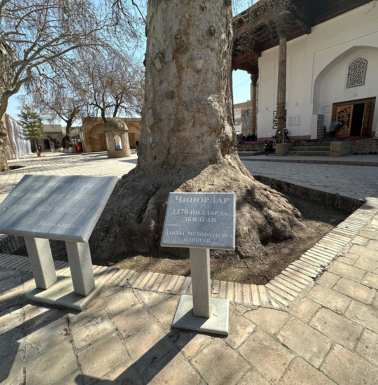
In the midst of all the cycles of building and destruction, there’s a remarkable survivor, a living, 750-year-old plane tree. I love trees. May it continue to thrive.