
Fergana Valley to Khiva – Immersive Bukhara
We drove from site to site in Samarkand
Either the distances or the busy traffic alone would have been enough to stop us walking everywhere. By contrast, in Bukhara, we walked, and only once took an excursion by car.
Bukhara city is more than 2,000 years old and was known as a great center of scientific and philosophical inquiry for more than 300 years from the Arab conquest in 709 up to about 1000 or 1100. The old city was destroyed by Mongol invaders in the 13th century, but again in the 16th century Bukhara reached another high point of culture and wealth, if not intellectual creativity. There are some exceptional survivals of early monuments, but most of what tourists come to see and experience dates from the 16th century.
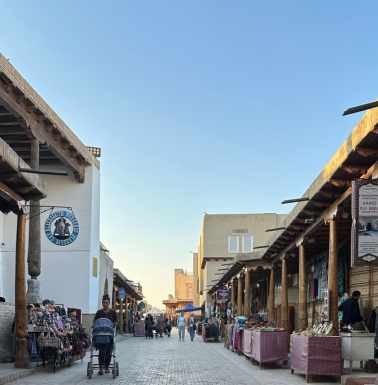
Today, this city that was once the capital and one of the greatest cities of all Central Asia, has a walkable center that UNESCO describes as one of the best examples of preserved Central Asian Islamic cities of the 10th to 17th centuries. There are plenty of architectural ensembles to talk about, but the holistic townscape is the star. Bukhara is like a film with a great ensemble cast – all great, even better together.
However, my first impression was nothing like what awaited. Bukhara’s main train station is in a small town 12 km, 7 miles, from Bukhara city. A driver was waiting as usual, and our drive to my hotel in old Bukhara seemed like a long ride through dusty exurban construction sites. And then there was more dust – Bukhara’s historic center was being spruced up for a biennial later in 2025, so my driver parked a way off from the hotel and seemed to labor a little to get my suitcase over the sand and scattered stones in the construction zone. Really, the suitcase wasn’t that bad – I carried it up and down more than one flight of stairs. In any case, we got my things to the hotel, and that was the last I saw of driver number one.
My lovely guide met me at the hotel and from there we walked everywhere in historic Bukhara. We also took a morning drive to visit some important sites near town. She was busy. I think she met me directly from another job, and just after the conclusion of my guided visit at midday on my last day, she had to dash to a translation engagement.
As all my guides did, she started with an orientation to local history, which she began to detail as we walked through a rather dreary amusement park. But soon she was illustrating her history lesson literally by the first places we visited: Chashma Ayub Mausoleum and Water Museum, the 10th century tomb of Ismail Samani; the great fortress (the Ark of Bukhara) with its partially restored 16th century walls; and the 11th century Kalyan minaret.
An oasis at the edge of the desert
Like other great Silk Road cities, Bukhara is an oasis, once the site of marshes and pools here in the Zarafshan river delta. Bukhara is at the edge of two deserts – the Kyzyl Kum, or Red Sand, and the Kara Kum, or Black Sand – making it an essential stop along the Silk Road. (My trip on to Khiva was by car across the Kyzyl Kum.)
There were also storks. Marshes and streams with abundant fish, frogs, and insects were nearby, and in town, tall buildings – ideal for storks. They became such a powerful symbol of Bukhara that today, long after the marshes have dried and the storks have left the city, it’s common to see fake stork nests on towers and domes. (I did see real stork nests, mostly in the Fergana Valley.)
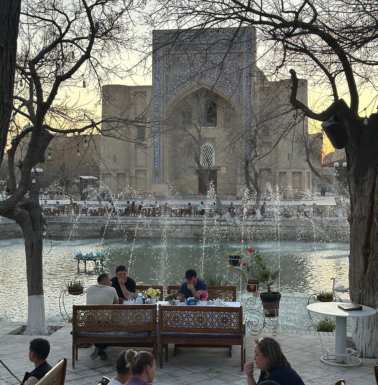
For centuries water was supplied to neighborhoods through a system of canals and pools; depending on your source, you might find that 100, even 200, pools, or hauz, existed in Bukhara. Very few remain, but especially at the Lyabi-Hauz ensemble, the feeling of community life around the local pool lingers, even if now it seems to be mostly tourists enjoying the sweet evenings.
Chashma Ayub (Spring of Job) Mausoleum and Water Museum
Water Museum? Yes, and it is fascinating, but I read that most tourists miss the Chashma Ayub (Spring of Job) Mausoleum which along with some unremarkable tombs contains the Spring of Job and the Water Museum, where my guide deposited me right away for my edification. “Water is life” takes on a special meaning at the edge of deserts. Museum displays and historic exhibits detail the history of Bukharan water management from the early days of its sophisticated hydrological infrastructure to water carriers selling wormy water in bazaars, and various present day management schemes, including some ecologically questionable Soviet plans.
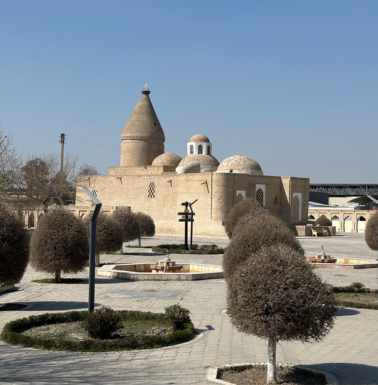
The real story here, though, may be the sweet spring of the Prophet Job where pilgrims still drink. (I didn’t.) Legend says that during an especially bad drought, Job struck his staff on the ground which caused a spring to appear, whose water cured him of his boils and ulcers, and saved his followers. A building was raised here in the 12th century, but my understanding is that the unusual conical dome dates from Amir Timur (Tamerlane) in the late 1300s and might reflect the shape of nomad tents.
From the Ismail Samani Mausoleum into town
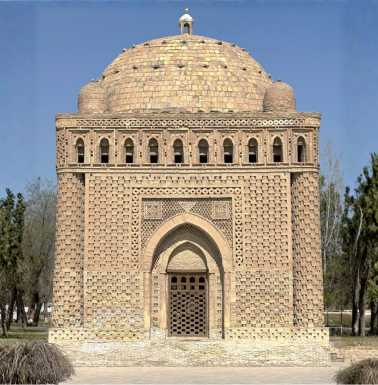
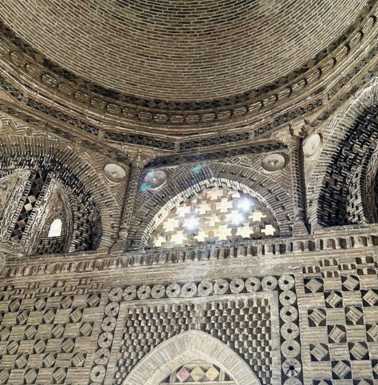
The Chashma Ayub is austere, but the nearby Ismail Samani tomb is a masterpiece of 10th -century Muslim architecture. This small building of baked brick is said to be the best surviving example of 10th century architecture in the whole Muslim world. The building is renowned for its perfect geometry and the intricate patterns of the brickwork which display pure geometric principles as well as various religious symbolism, including Islamic and Zoroastrian. For generations, though, the building was covered by sediment and sand, which probably saved it from destruction when Genghis Khan razed the city in 1220. It stands nearly alone in a park now rather than at the center of the ancient cemetery which was turned into today’s park by the Soviets (who also discovered the Ismail Samani Mausoleum).
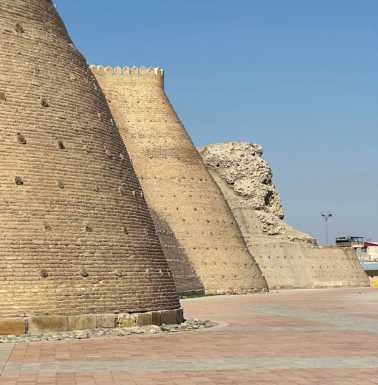
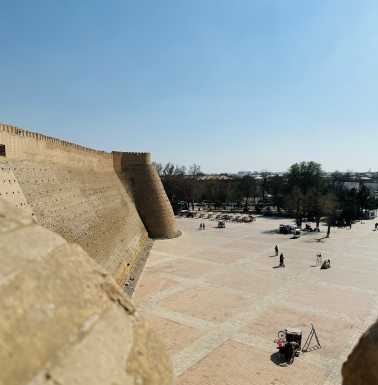
From the Ismail Samani Mausoleum, we walked along the walls of Ark of Bukhara, the historic citadel. While a citadel was on the site before the year 1000, the present citadel and the impressive walls, a section of which has been restored, were built in the 16th century. The next day, we revisited the citadel but that afternoon, as we walked along the base of the walls, the view was impressively upwards.
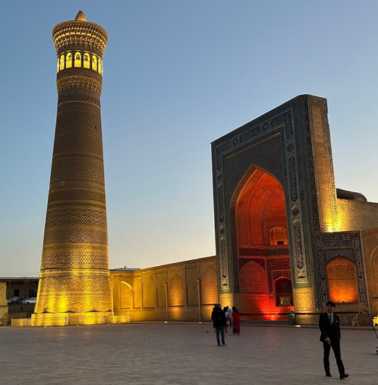
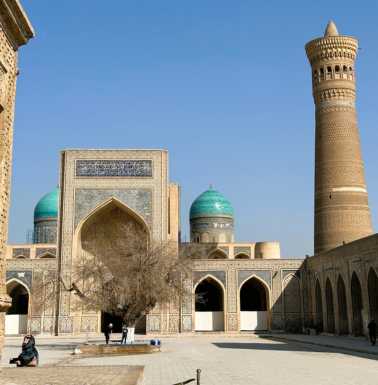
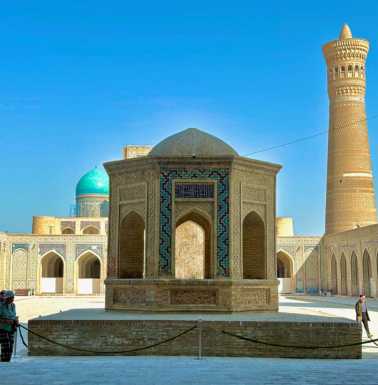
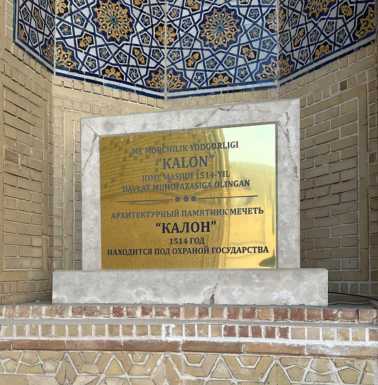
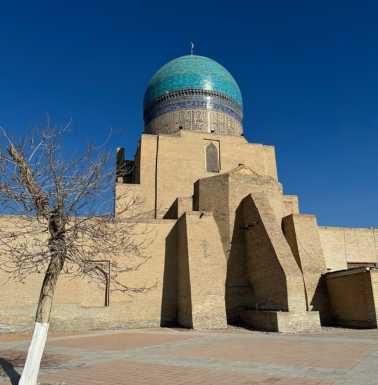
Our next monument, the Kalyan minaret (the Tower of Death), dates from 1127 and like the Ismail Samani Mausoleum, is ornamented in stunning patterns of baked brick. It is tall at 45.6 meters, about 150 feet, and is called an unlikely survivor of the city’s early days. Legend says that Genghis Khan was so awed by the tower that he ordered his army to spare it when they destroyed everything else, including the next-door mosque – today’s Kalon Mosque dates from the 1500s. The minaret got its unhappy name because at one time condemned criminals were executed by being thrown from the top. The tower, the Kalon Mosque and the Mir-i-Arab Madrasah form a religious complex at the old town’s center, the Poi-Kalyan.
We continued walking everywhere, one of the beauties of Bukhara’s core. On my free afternoons, and in the evenings, it was easy to get around and enjoy the old town on my own. To help me with my roaming, my guide retrieved a paper map of Bukhara’s core from her nearby home. I did not see all the monuments labeled on the map – in a way, ticking monuments off one-by-one would have missed a point. This was an old city where I learned about history and architecture, saw much that was of importance, but also had the chance to wander around, get a little lost, backtrack, make discoveries, and sit to absorb a sense of place.
A great trading city
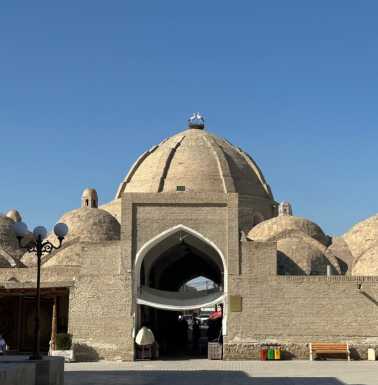
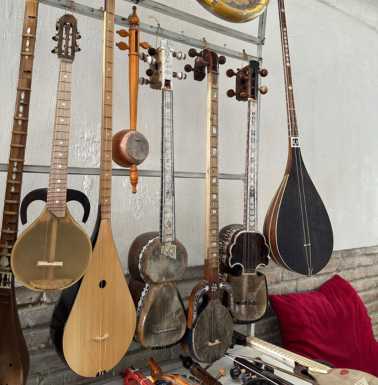
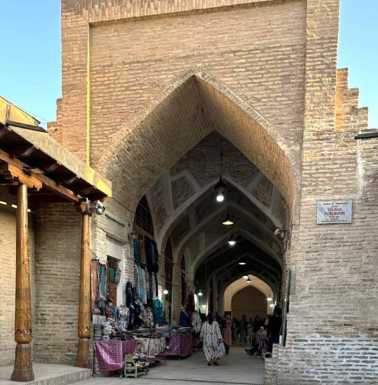
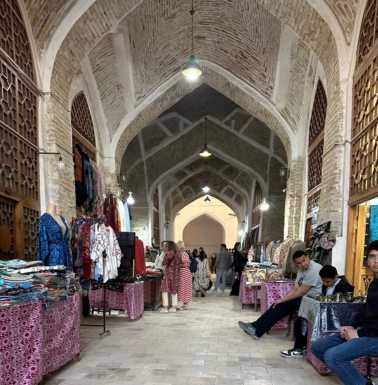
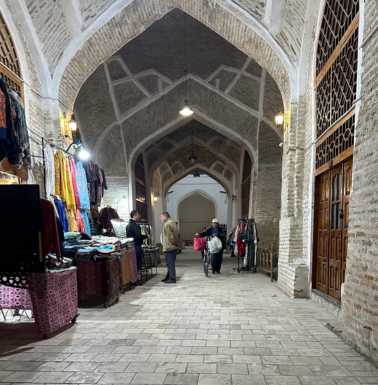
Bukhara was a trading city and the “trading domes” at the city’s crossroads were its important specialized markets. Four extant domes (of five) remain marketplaces selling everything from traditional musical instruments to handmade knives, clothing of all sorts, artworks, and a host of miscellany. The trading domes are also notable architecturally, with the height of their passageways, thick walls, and system of small domes still today keeping the markets cool (or coolish) in intense heat. My guide also explained that the width and height of the passageways was enough to allow fully loaded camels to pass!
In Silk Road days, each of the five markets was focused on specific trade – jewels, money changing, leather goods, food, and so on but among the variety of goods I saw, it wasn’t clear whether the markets are still specialized.
More about the Poi-Kalyan complex
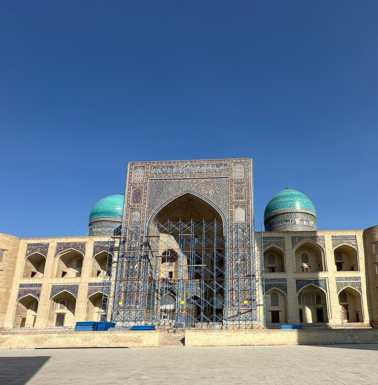
I’ve already mentioned that one of the first places my guide took me was the Poi-Kalyan complex with its striking minaret. I returned here more than once. Most sources call this the heart of the city, the jewel in the crown, the most beautiful place in the city, or “the spiritual and architectural heart of the city.” It is certainly the most impressive, even if I liked relaxing at Lyabi-Hauz better. There are three principal monuments among a larger group: the 16th century Kalon Mosque and facing it, the Mir-i-Arab Madrasah with the 12th century minaret between them. The Kalon Mosque is one of the largest in Central Asia, while the Mir-i-Arab Madrasah, completed around 1535, continues to serve its original function as a place of study, making it the longest continually functioning Central Asian madrasah.
Lyabi-Hauz Ensemble
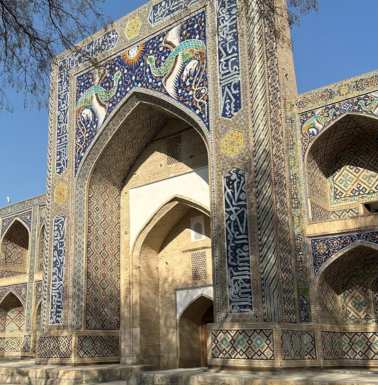
The 16th and 17th century Lyabi-Hauz Ensemble is another old town center that these days seems more to be taken over by tourists than local people. But it remains a beautiful place to drink tea or have dinner – or even just sit – and perhaps reflect on the days when local people gathered to relax, socialize, or wash at the pool. The pool itself was ordered built by the Grand Vizier (the top executive officer and chief advisor to the Emir), Nadir Divan Beghi, around 1620. Three splendid buildings are arranged around the pool: the Nadir Divan-Beghi Madrasah and the Nadir Divan-Beghi Khanaka (a khanaka is a place of rest and worship for Sufis), both built in 1622, and Kukeldash Madrasah built in 1568 – even before the pool was created. Most sources say that the mulberry trees around the pool are older than anything in the ensemble, dating from the late 1400s.
A Jewish widow gets a synagogue near Lyabi-Hauz
Bukhara once had a thriving Jewish population. In fact, the so-called “Bukharan Jews” are considered one of the oldest ethno-religious groups of Central Asia. Bukhara’s old Jewish quarter and synagogue are not far from the Lyabi-Hauz ensemble and according to legend there is a connection between them.
My guide shared this story, and I have also read it. In the 17th century, when Grand Vizier Nadir Divan Beghi was building today’s Lyabi-Hauz Ensemble, he wanted to build large pool, but a Jewish widow’s courtyard was in the way. For several reasons, he couldn’t just take it, so the Grand Vizier asked her to sell the courtyard at any price. She refused. Then his friends suggested building a small canal just beside the widow’s house, and as they planned, the water began to undermine its foundation. The widow then approached the Grand Vizier offering to sell her house, not for money but instead for a site to construct a synagogue. He gave a nearby piece of his land, a synagogue was built, and it is said that the widow lived on the top floor thereafter. Her name is not known.
Bolo Hauz Mosque
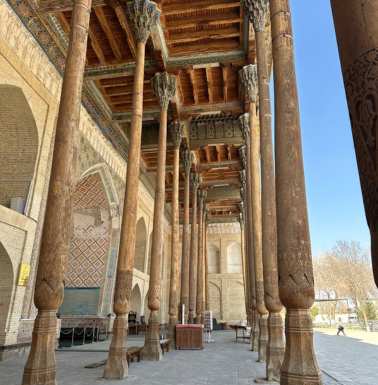
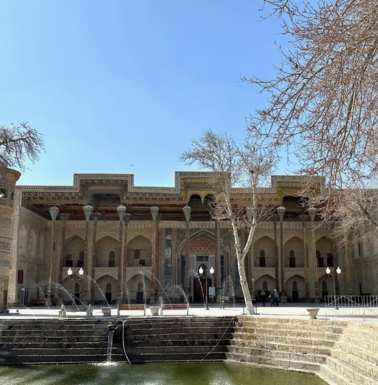
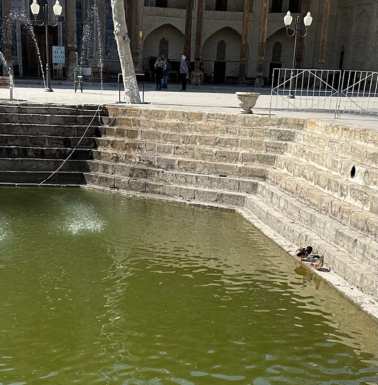
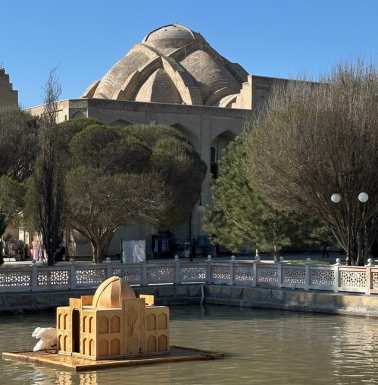
The Bolo Hauz Mosque faces a pool, and on beyond that, the Ark (fortress). This area was once the Registan, or main square, which included administrative and other important buildings of which only the mosque remains. The mosque dates from the 1600s and is particularly elegant because the Emir (the supreme ruler) had it built as his place of worship. It is still a functioning mosque. The iwan (a portico enclosed on three sides) features twenty exquisite carved wood columns. The mosque is also called the forty-column mosque, because the twenty columns are reflected in the pool, doubling their number. The Internet abounds with pictures of this reflection, but each time I walked by, fountains disturbed the water, and I saw no real reflection. However, I did see some ducks preening on the steps, and a turtle swimming in the green water.
Chor Minor
A minor speed bump in getting to know Bukhara was the streets being torn up for improvement projects. In any case, I learned where to walk and most places of interest were easy to reach, although getting to see the four-tower Chor Minor was like walking through a job site. I was usually good enough at picking my routes, but this time I hadn’t paid quite enough attention.
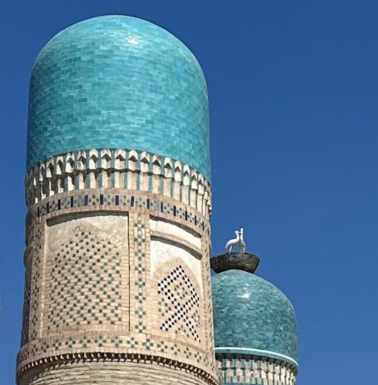
Chor Minor is an unusual little building that was built as the gatehouse for a madrasah that no longer exists. And, it is relatively young, constructed in 1807 by a rich Turkmen merchant. Even though “Chor Minor” means “four minarets” in Persian, the towers aren’t minarets – they are simply decorative.
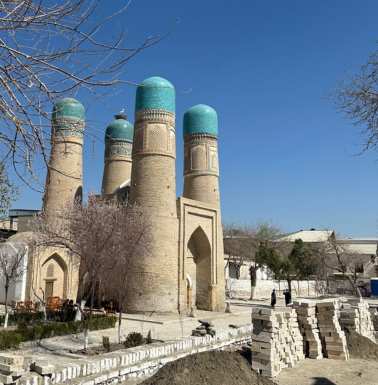
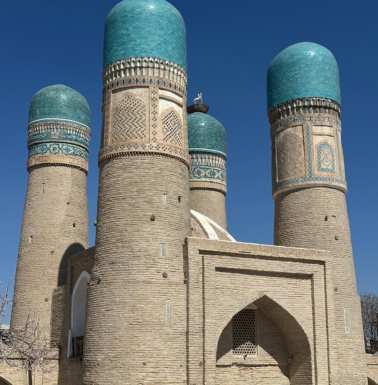
If you research Chor Minor, you may find varying accounts of its architectural influences, and the symbolism of designs on the towers, but it is a charming building complete with its own fake stork nest, and I like the legend someone told me – that the towers differ because they were intended to represent the builder’s four daughters.
Memorial Complex of Khoja Bakhouddin Naqshbandi
On our excursion outside town, we visited two important holy sites, as well as the summer palace built by the last Emir of Bukhara. My guide and I met early, and a new driver picked us up for the 12 km, about 7-mile, trip to Kasri Orifon and the Khoja Bakhouddin Naqshbandi memorial complex, one of the most important Muslim shrines, followed by a visit to the Chor-Bakr Necropolis.
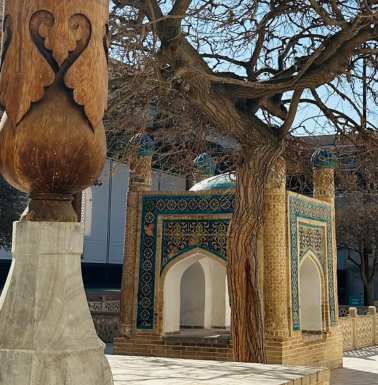
Khoja Bakhouddin Naqshbandi was a revered Sufi philosopher who founded the Sufi order named in his honor – the Sufi order of Naqshbandiya. He was also the spiritual instructor of Amir Timur (Tamerlane). Numerous websites call the memorial complex the “Central Asian Mecca,” reflecting its importance as a pilgrimage site. The complex was started after Bahouddin Naqshband died in 1389 and has continued to develop. It has long been a place of pilgrimage, reflection, and meditation.
I believe you could see the huge dome of the khanaka, the Sufi hostel and gathering place, from the highway. It is so unlike the many other domes I saw that I have wanted since then to find out more about it. The importance of this site is spiritual more than architectural, and I never found exactly what I wanted. What I did find, though, is that the khanaka was built in 1544, and the dome is thirty meters (just under 100 feet) high.
The pool was built in the 18th century to meet the water needs of pilgrims and to provide cool air. The various ponds in the complex are filled with water from nearby streams.
Chor-Bakr Necropolis
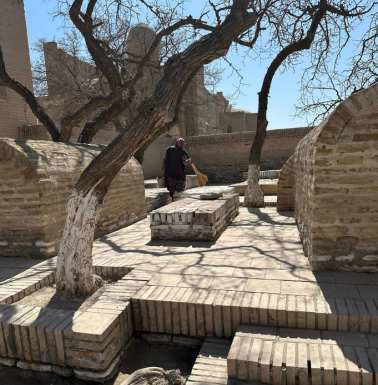
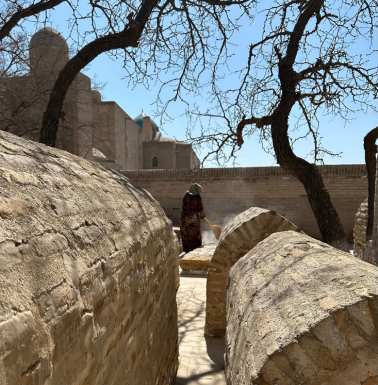
The important Chor-Bakr Necropolis, also called the city of the dead, is a large ensemble just outside Bukhara, where Abu Bakr Said, a descendent of the Prophet Muhammad, was buried. Later, his descendants were buried alongside him, and the site became a place of pilgrimage and prayer. Much later, a mosque, madrasah, and khanaka were built.
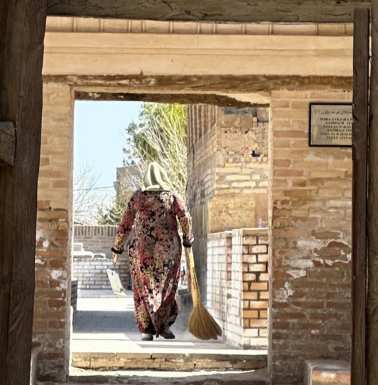
I was struck by the simplicity of the decoration, with many tombs undecorated and others with only “inserts” of colored tiles. The overwhelming look was sand-colored, like so much I saw around Bukhara. Women with brushwood brooms swept the tombs of that constantly blowing sand.
Sitorai Mokhi-Khosa – the last Emir’s palace
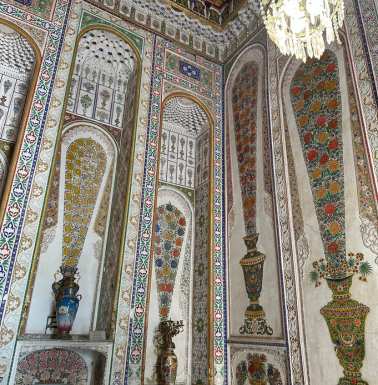
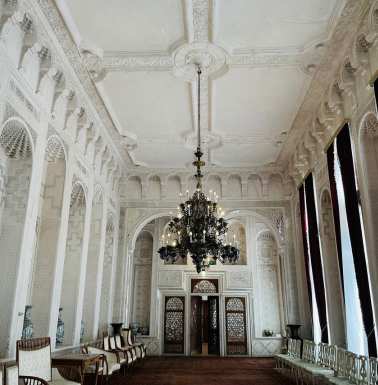
The current Sitorai Mokhi-Khosa Palace was built in 1912-1918, by order of the last Emir of Bukhara. Its design reflects an interest in both European art and local design. The construction involved Bukhara masters and two Russian engineers. In fact, its 19th century “Russianness” was my first impression. The Emir didn’t have long to enjoy the palace though, as the Bolsheviks arrived soon after the palace’s completion. The main building consists of several reception halls and the Emir’s private rooms. The lovely White Hall was decorated by the Uzbek, and eventually Soviet Uzbek master, Usta Shirin Muradov.
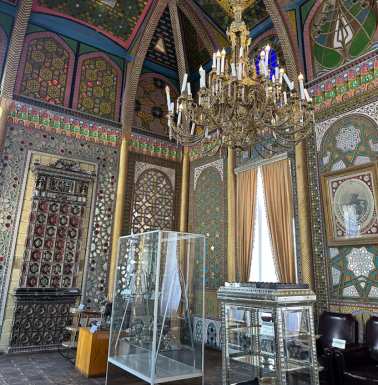
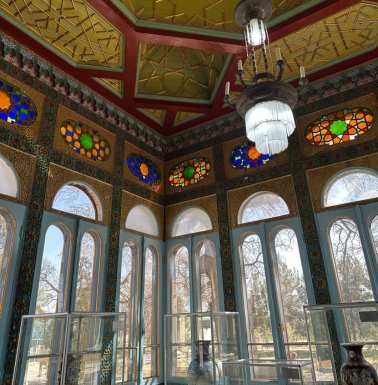
“Breaking out”
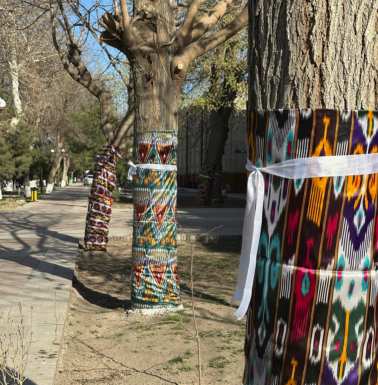
When I’m in a city like Bukhara, with its accessible, historic city center, I nevertheless enjoy getting out sometimes. In Samarkand, that was easy; I wasn’t staying in a “center.” In Bukhara, it was a matter of following streets beyond the historic center. Sometimes, I saw people apparently going about normal daily business, or more street repairs, or restaurants with local patrons. Even a convenience store. And once I came upon a row of trees wrapped in colorful fabrics – was this a design or school project, or was it for Nowruz, the ancient Persian New Year celebrated at the spring equinox? Whatever the reason, they made me feel good.
Leaving for Khiva
I was sad to say goodbye to my guide. We parted at an intersection of lanes in the old neighborhood, and she hurried to her next job with one of her sons who was heading to afternoon school classes. I spent the afternoon and evening roaming around. I have no recollection of dinner that last night and unhappily didn’t take good notes. One night I’d picked a restaurant where I ate pelmeni and pumpkin soup in the open air, near a small group of laughing French people. Another night, I picked a restaurant where I was one of only two patrons inside, and the lamb shashlik was too tough to chew. I picked this because no tour buses were parked outside. Maybe the buses are a good sign after all.
On the morning I left, breakfast was delayed by a stove problem, and when I finally got to the breakfast room, only two tables were set – a large Russian tour group had left the day before and hardly anyone remained. The woman who cooked breakfast was fun to talk to in what Russian I could muster, and she made me more food than I could possibly eat. Later, she gave me a sprig of mint which I tucked behind my ear. “Uzbechka,” she called me, smiling.
A young man at reception told me my driver was waiting. I found him outside, a big guy with close cut hair and dark sunglasses. He was going to drive me six hours across the Kyzyl Kum desert to Khiva, and he looked like he could handle anything that might happen along the way. And so began the last part of my Uzbek adventure.