
Fergana Valley to Khiva – Samarkand
Samarkand
Samarkand was the place I tried to get to all those years ago when I was a student. Now decades later, it’s an important tourist destination, and a spread-out, fast-growing city of nearly 600,000, unlike the sleepier place I’d have visited back then. Happily for me though, it was early in the tourist season, and the biggest groups I encountered were school classes.
A note about spellings
There are different systems of “romanizing” languages written in non-latin alphabets and scripts, that is, converting sounds of the source language to generally equivalent latin-alphabet sounds. So, if you research places and names, you’re likely to find various spellings. I’ve made spelling choices from looking at English language materials and web sites. Non-English latin-alphabet materials will likely show yet more options, as does my French guidebook (petit futé Ouzbékistan). I hope my spellings work for you.
A faster train trip this time
I took the fast train from Tashkent (a Spanish Talgo) with smartly attired crew sporting dark navy coats with Persian lamb collars. This was a spiffy upgrade from the old Soviet-style train I rode (fondly, actually) on the Fergana trip. I arrived early at the station back in Tashkent and when I tried to saunter onto the platform to check out things, a guard pointed to the jammed waiting room and said in English, “Early! Sit!” I complied.
Unlike the Fergana train, this one was full, and I sat at a table with strangers. No moving around to get a better view this time. But it was a relatively quick trip, and once in Samarkand I followed everyone else out to the parking, where my guide picked me out of the exiting throng. Was the instruction to look for a lone foreign woman? We threw my things into the car and headed off sightseeing right away. After spending three days with this guide, including a day trip to Shahrisabz, it felt like I was leaving a friend when I went on to Bukhara.
We drove from one world renowned monument to the next, so I’ll describe them like that, one after the other. In between stops, we talked about what we’d seen or would see next, and we were able to stroll a bit. But I found this pretty much a driving town.
After the “monument list,” I’ll finish with Ulugh Beg’s Observatory, the Afrasiab Museum, and a papermaking workshop, and then a little about my neighborhood.
Tamerlane’s Tomb
Certainly, one of the main reasons tourists come here is to see the mausoleum of Tamerlane, or Amir Timur, the conqueror who founded the Timurid Empire and who along with his successors is responsible for the city’s gorgeous architectural and historic monuments. Tamerlane was known for the brutality of his empire-building, and though he lived from 1336 to 1405 and made Samarkand his opulent capital, he seldom visited the city, preferring to remain on the move with his army. He never even intended to be buried in the grand mausoleum he’d had built for a grandson, the Gūr-e Amīr, but in a dynastic memorial complex in his birthplace, Shahrisabz, across the Zarafshan mountains from Samarkand. But here he wound up, because he died in today’s Kazakhstan in winter (this is accurate) and supposedly mountain passes to Shahrisabz were snowed in and impassable (this is probable).
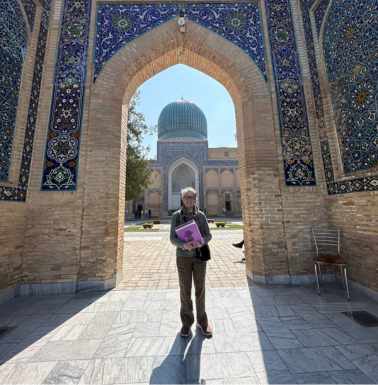
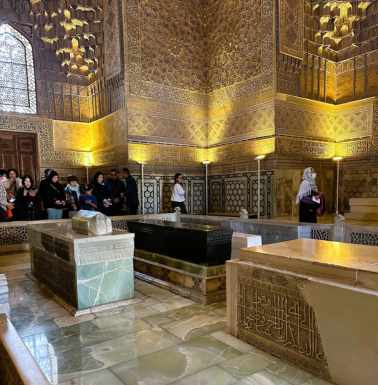
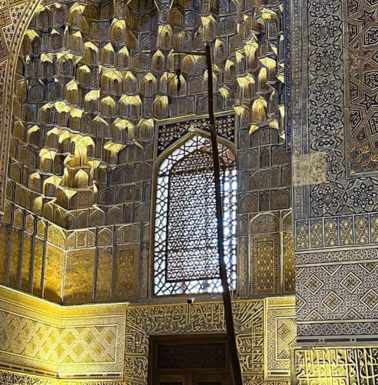
Tamerlane is not the only Timurid buried here. Grandsons Muhammad Sultan and Ulugh Beg are here, as are two of Tamerlane’s sons, Miranshah and Shahruh. Tamerlane desired to be buried at the feet of his teacher, Mir Said Baraka, who is also in the mausoleum. The stone tombs, including the jade “tomb” of Tamerlane, are, in reality, representations of where the bodies are buried in the crypt below.
Registan
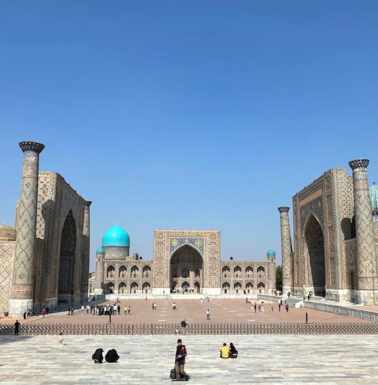
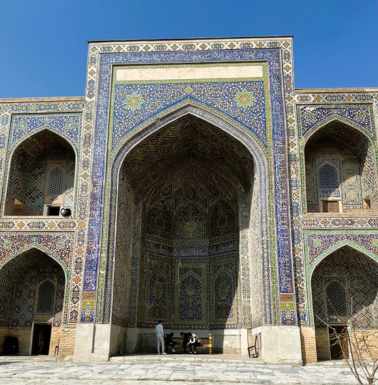
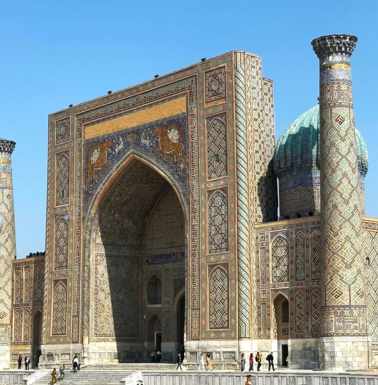
This might be the first place a tourist sees. If not, it will surely be the second after Tamerlane’s mausoleum. For Registan is the spectacular Timurid grouping of three madrasahs, centers for Islamic education and inquiry, built during a period of just over 200 years – the Ulugh Beg Madrasah, Sher-Dor Madrasah, and Tilya-Kori Madrasah.
Madrasah Ulugh Beg
Ulugh Beg’s eponymous madrasah, Registan’s oldest, was built during the rule of Tamerlane’s scholarly grandson between 1417 and 1420. My guide used this madrasah to educate me about decorative techniques, explaining and showing majolica, mosaics, and glazing as well as certain design conventions. Then she’d look for something subtle and quiz me. I paid attention and passed her tests (she didn’t make them too tricky). The large, vaulted spaces, or iwans, were often used as open summer classrooms.
Sher-Dor Madrasah
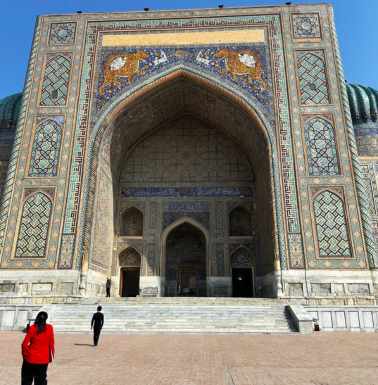
When this madrasah was completed two hundred years after Ulugh Beg’s, in 1636, Samarkand was ruled by a military governor representing the Bukhara dynasty. How things change! The decoration on the façade is the source of the Sher-Dor name, which basically means home of lions. The composition depicting two lions chasing deer (each lion with a sun on its back) was a Persian-inspired design of mythical beasts and probably therefore avoided the prohibited depiction of living animals or human beings in holy places. The beasts contribute to the enigmatic quality of the portal which was most likely approved by the then-ruling khan.
Tilya-Kori Madrasah
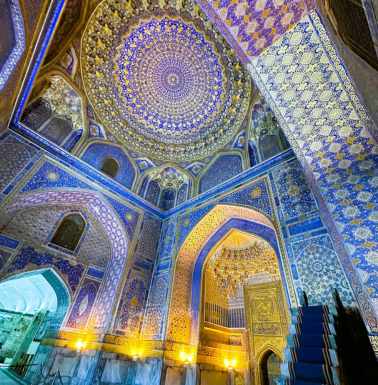
Tilya-Kori is the last of the Registan’s major buildings, completed a generation later (1646-1660). It was built under the same military governor as Sher-Dor, but it wasn’t fully finished when he died in 1655 or 1656. Only in the twentieth century during the Soviet period when the prayer hall’s outer dome was at last finished, did the building become complete.
The name Tilya-Kori means decorated with gold, and the beautiful prayer hall explains – it glistens with mesmerizing gilding. Tilya-Kori was both a madrasah and Samarkand’s main Friday Mosque. My guide saves Tilya-Kori until last for her guests, the “best for last,” she says, “the reveal,” I thought. Stunning, opulent, but the delicacy of the design saves it from being garish. Beautiful.
A couple of Registan-related factoids
- “Registan” is derived from Persian and means “place of sand.” Regi – sand, and stan – place. It was originally the great sandy square where royal proclamations were announced, and other business took place.
- Ulugh Beg, during whose reign the first Registan madrasah was built, was a scholar, a mathematician, and astronomer who, among other things, built an observatory and made highly accurate celestial observations. He was described by one source as “relatively enlightened,” but his power political skills were deficient, and he was assassinated in 1449 on his own son’s order.
Bibi-Khanym Mosque
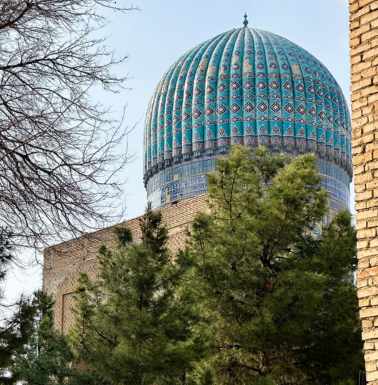
Reaching back again to the period of Tamerlane himself, our next stop was the enormous, partially restored mosque named for Tamerlane’s senior wife, Bibi-Khanym. This was designed to be the biggest mosque in the Muslim world, and when first built it held 10,000 worshipers in the courtyard. It was completed by 1404 but was too big for the construction techniques of the time and soon began to crumble of its own weight. It was also damaged by earthquakes but now, after a partial reconstruction by the Soviets, it’s easy to sense the original grandeur. Tamerlane himself supervised construction between his military campaigns, and in his absence, it is said that Bibi-Khanym oversaw progress.
Shah-i-Zinda
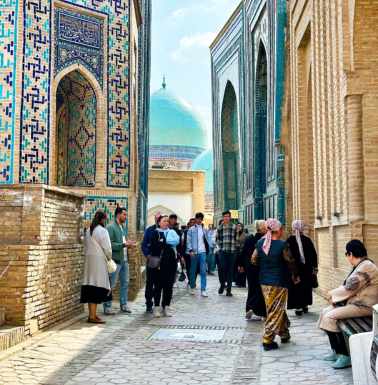
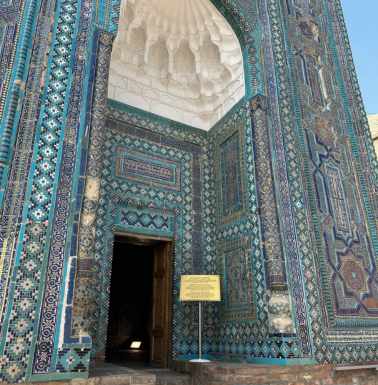
This remarkable necropolis – burial place – where Tamerlane and Ulugh Bek buried family and favorites is one of the most beautiful displays of Muslim tilework in the world. Shah-i-Zinda means “The Living King” in reference to the holiest of the shrines, the grave of Qusam ibn-Abbas, a cousin of the Prophet Mohammad, who according to legend, brought Islam to the area in the 7th century. Much of the tilework on the tombs dates from the 14th and 15th centuries. As a holy site, Shah-i-Zinda is a place of pilgrimage and prayer.
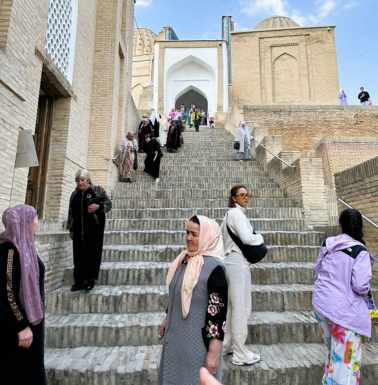
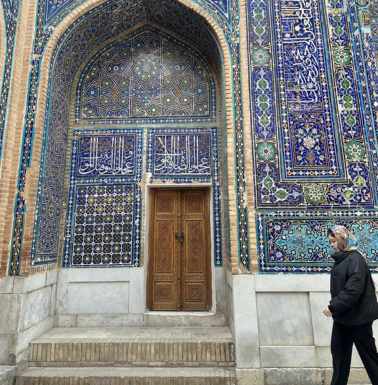
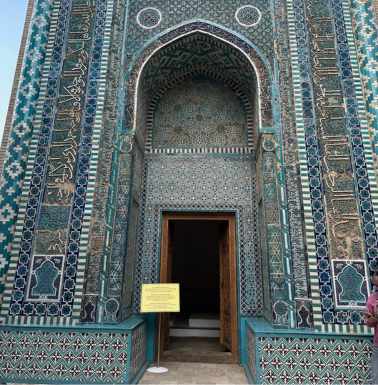
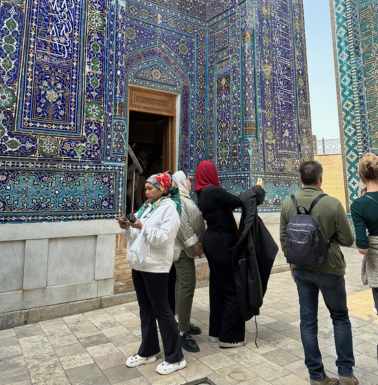
There are 36 steps up to Shah-i-Zinda. I counted 36, and there are web sites (e.g., Silk Road Adventures) that also say 36. Other sites say 40. In any case, there are traditions and legends tied to the step-count. One tradition is to pray on each step. Another is that if you get the same number going up and coming down, you are free from sin. More playful traditions involve granting wishes – equal counts and your wish is granted. But if your count’s not the same, then my guide told me that I’d have to do penance for forty days. I figured I’d have to stay in Samarkand for that, so it wasn’t all bad, but I got the same number each way. I asked how you could miscount, and she thought that typically, it’s forgetting to count the first step coming down.
Something to ponder
In researching certain facts for this post, I came across several sources that refer to a 2005 restoration at Shah-i-Zinda that caused some controversy. I cannot ignore but won’t pursue this question here because if it interests you, it’s easily searchable. Still, I believe that what I saw is substantially the same necropolis that over the centuries has arguably needed little repair.
And then, St. Daniel, or the Prophet Daniel
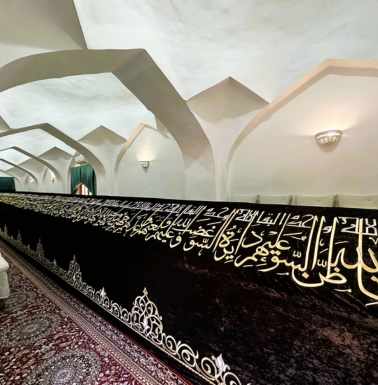
Daniel who could interpret dreams is either a saint or a prophet for the three Abrahamic religions – Islam, Christianity, and Judaism. At least six cities claim to have his remains, of which Susa in Iran is most likely. But it is also said that Tamerlane brought the saint’s (or prophet’s) bones to Samarkand after one of his conquests. Legend says further that the body and thus the sarcophagus grow continuously, with the sarcophagus now being 18 meters long. Others say the size of the sarcophagus was a deliberate ploy to conceal the bones and thus foil grave robbers.
The pistachio tree
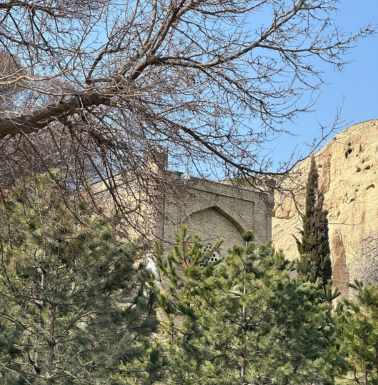
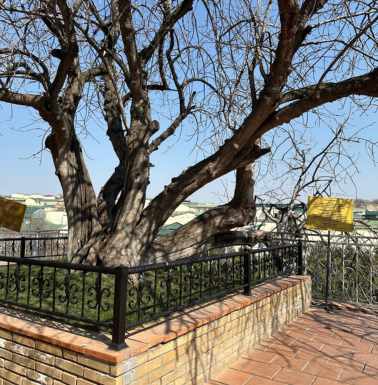
There is a 650-year-old pistachio tree near the tomb that was dead and dry when in 1996, the then-Russian Orthodox patriarch visited Samarkand, and sprinkled holy water on the tree, after which it bloomed. However, it hasn’t bloomed since. The day I visited, there were a few ribbons tied to the tree, for luck, healing, or some form of veneration. My guide and I sat on a bench near the tree, in view of a hermit’s cave in the cliff face, discussing legends, hermits, prayer, and religions, a very personal conversation in an evocative place.
Ulugh Beg’s Observatory and the Afrasiab Museum
You could walk from the observatory to the museum in under 20 minutes (one site says 10), and although we drove to have the car handy, we had a chance to stroll a little in green parks near each site. However, although close geographically, the two represent quite different periods of local history.
Ulugh Beg’s Observatory
As noted in the Registan Factoids, Ulugh Beg’s son had him assassinated in 1449, after which his observatory was leveled, its library, said to have thousands of books, was looted, and all the scientists driven away. Later, a nephew worked to restore Ulugh Beg’s reputation, and had his remains placed in the Gūr-e Amīr with Tamerlane and the other Timurids.
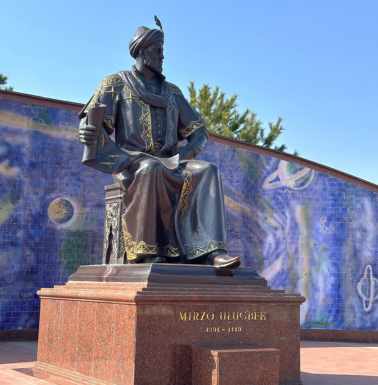
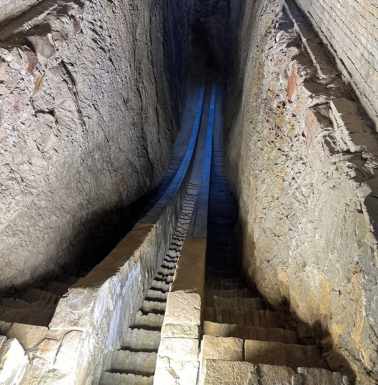
The observatory featured an enormous quadrant (called a sextant because only 60 degrees were used, according to sources). When fanatics destroyed the observatory after Ulugh Beg’s murder, they neglected the underground portion, which is what we can see today. The nearby observatory museum displays copies of the observatory’s star tables, which are astonishing in their accuracy.
Afrasiab Museum
Early Samarkand, then known as Afrasiab (or Marakanda), was founded in the 7th century B.C. and became the chief city of the powerful state Sogdiana. The entire city was destroyed by Genghis Khan and the Mongols in the 1200s. The survivors abandoned the hilly ruins and migrated not far away, leaving behind what is now an important archeological site. The Afrasiab Museum shares its history. I have no pictures but if Afrasiab interests you, it’s easy enough to find web sites, including pictures of the frescoes I describe below.
When I went, parts of the museum were being reset although the organization and intentions of the curators were clear, and the exhibits on view all remarkable, if not colorful, treasures. But one of the most significant finds is fully accessible for viewing. It’s so significant that my guide also saved it as a surprise – her “best for last” approach!
The highlight I’m referring to is a series of 7th century frescoes that once decorated the reception hall of King Varhuman, who ruled Sogdiana from 655 to 690. The frescoes are fragile, and parts are mere fragments. But in the display hall, the frescoes and fragments are arranged on four walls just as they were in King Varhuman’s palace. They illustrate a series of processions bringing offerings and gifts to the king from various parts of the world.
There’s also a film available in several languages.
Samarkand paper – the best on the Silk Road
How do we get from madrasahs, observatories, and ancient frescoes to that ubiquitous stuff, paper? Because paper was one of the most significant trade goods on the Silk Road. UNESCO calls paper an important but perhaps overlooked trade good “which had a significant impact on the course of human history.” The paper trade and spread of papermaking technologies “greatly improved our collective abilities to record, store, and transport knowledge and information.” It was principally Samarkand paper that eliminated dependence on papyrus and parchment.
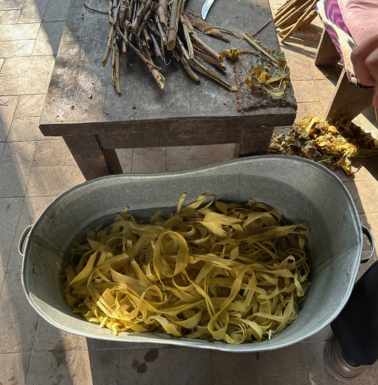

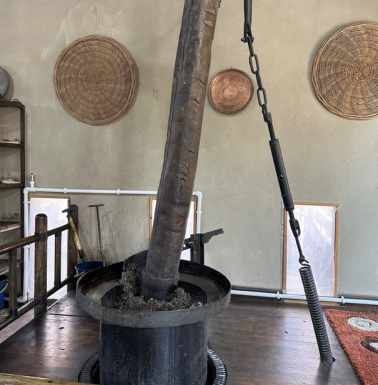
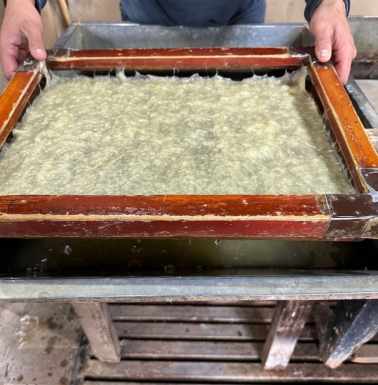
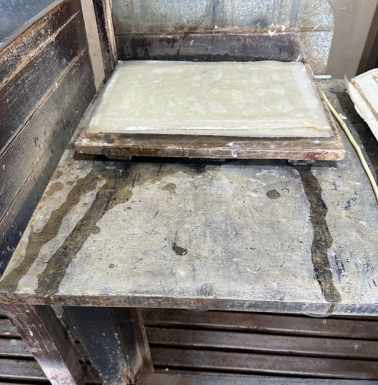
Paper is a Chinese invention, but once the secret of making paper was obtained in Samarkand, the local craftsmen improved the process and quality by applying their own new techniques. Samarkand paper went as far as Europe in trade, and such is its durability that documents written on early Samarkand paper still exist in museums.
Traditional papermaking involves these basic steps. First, the inner bark is stripped from mulberry shoots, is soaked, and then boiled. The boiled bark is pulverized using a water mill and the pulp dried in frames. The paper is pressed and burnished and can be dyed. A lesser quality paper can be made using silk waste along with other vegetable fibers.
Close to Samarkand at Konigil, the Mukhtarov brothers have established the Konigil Meros Paper Factory dedicated to replicating the ancient art of papermaking. The workshop is popular with tourists, and I enjoyed visiting and having snacks and conversations with an international group of visitors. The site is green and pleasant, like a garden, and the workshop also offers cooking classes for another way to enjoy a day out.
Finally, my hotel’s neighborhood and “fast-food central”
My little hotel street seemed unprepossessing when we drove up the first time, but I liked the hotel and its large, cozy lobby, the neighborhood was quiet, and I soon found that we were only a short walk from the lovely University Boulevard and the 19th century Russian district. Evenings were pretty, there were always people strolling along the boulevard, and I found parks and another Russian church to explore. As the sun set on those mild evenings, I kept my windows open and enjoyed listening to roosting birds, local kids playing, and the occasional voices of neighbors walking along a side street. Plus, the hotel’s breakfast buffet was the best of all my hotel breakfasts.
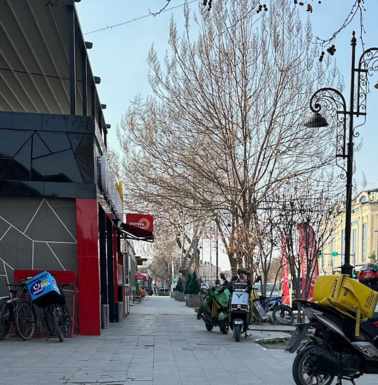
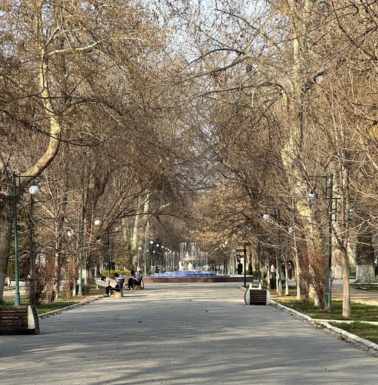
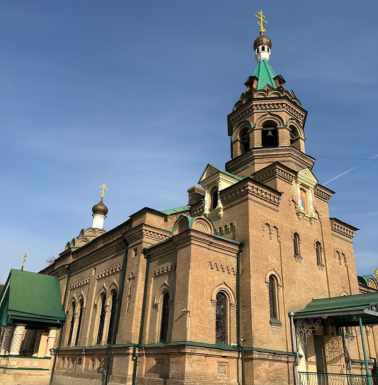
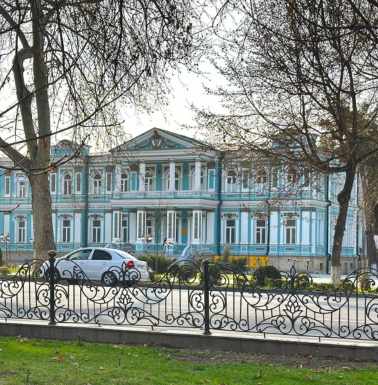
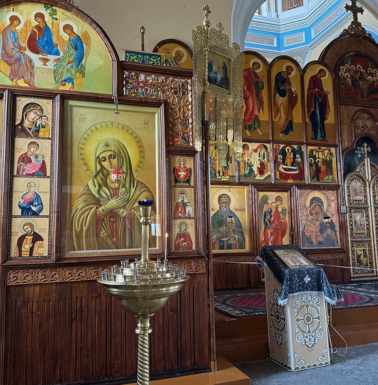
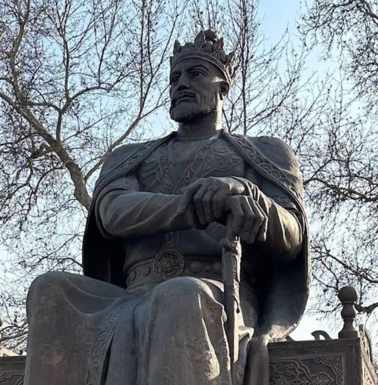
Fast food central
On the first day, my guide took me to a nice restaurant near Registan after our walk, helped me order a shashlik and salad (both very good) and tea, then tactfully said she needed to go charge her phone. Maybe so, but I then realized that she wasn’t eating during the day for Ramadan. That’s when I stopped having a midday meal – it wasn’t difficult for me, was easier for everyone, and gave me more time on my own in the afternoon.
Touring hours with my guide lasted until mid-afternoon, and as my driver had noted when he first brought me to the hotel, it was a block from “fast food central,” as he called it. I was ready to eat now, and my first thought was that I should go to a restaurant instead of a however-tempting fast food place, so I went to a restaurant down my little street. But try as I might, I couldn’t get anyone’s attention. There were very few people there – bad time of day, maybe?
But that was a good excuse to try fast food, and I found a nearby samsa place – samsa is a baked savory pastry stuffed with meat or sometimes vegetables. The samsa “café” had two tandoors on the street and a storefront with indoor seating. A man at the cash desk managed with my little bit of Russian and his slightly more English, and the samsas were hot and tasty. I also found a convenience store on my street which had enough for me to eat although without the fresh things that I wanted. Real restaurant meals awaited in Bukhara and Khiva, but I did enjoy those Samarkand samsas.
Leaving – on to Bukhara
My driver in Tashkent was a grandpa, and I enjoyed both hearing about life with grandchildren and his shepherding ways with me. When he took me to the train station for my trips to Fergana and Samarkand, he even walked with me to security to be sure all went well.
My Samarkand driver, on the other hand, although genial and chatty, took me to the train for my trip to Bukhara and just kind of said, “OK, here you are, bye.” I was briefly disoriented. But no matter that the digital timetable wasn’t working fully. I’d be going to Bukhara on the same train I’d come on to Samarkand, same track and all, so there I stood. I noticed some tourists speaking English, but didn’t join in. The train arrived and we went to different carriages.
Again, the train was full (if I haven’t said it yet, book well ahead for the fast trains) and we sped through countryside that I don’t remember at all. But then, there we were, Bukhara, with its walls and trading domes, where I went about mostly on foot, and ate at real restaurants.