The Silk Road by Train and Car; Introduction to Uzbekistan
My Story
My road to Uzbekistan goes way back to the USSR, when I was at university, taking a summer Russian course in Moscow. A friend and I wanted to go to Samarkand in Uzbekistan to see Tamerlane’s tomb. Tamerlane was a fourteenth century Central Asian leader, terrifying as a conqueror but also known as a great patron of the arts, literature, and architecture (and grandeur – he built big stuff). It was the architecture we wanted to see, and for an afternoon we traipsed around to Moscow’s official tourist offices, but the Soviets wouldn’t add Samarkand to the list of cities already on our visas.
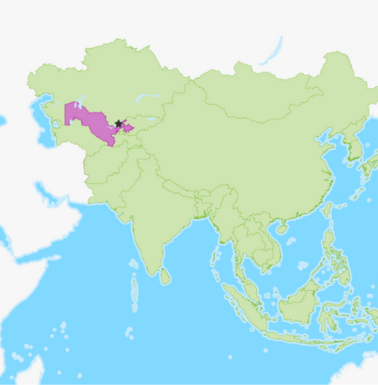
Then in March 2025, decades after that first try, I saw Tamerlane’s tomb, because now, it’s an easy trip (though it can be a long one), and the Uzbek government is encouraging tourism. Hard to get there back then; easy now. But where is it? Uzbekistan is a landlocked country right in the middle of Central Asia, south of Kazakhstan and Russia, north of Turkmenistan and Iran. To the east are some more stans (“stan” means “land of” or “place of”) and China. Go west and you eventually arrive at the Caspian Sea.
Uzbekistan, officially the Republic of Uzbekistan, is a landlocked country in Central Asia.
Why Go: the Silk Road and much more
Uzbekistan promotes its legends and ancient traditions, but most of us think “Silk Road” first. In reality, “silk road” – a term first used in the 19th century – doesn’t nearly describe the network of trading routes and goods that converged in Central Asia over thousands of years.
I learned that these extensive trade routes also made Central Asia a region where ideas about philosophy, religions, science and technology swirled and traded like other goods and led to Central Asia’s golden age of intellectual activity that is mostly unknown, in the West, at least. And many Central Asian discoveries are often attributed to Arab intellectuals, because Central Asian thinkers and scientists wrote mostly in Arabic after the Arab conquest. Along with scientific and artistic advances, they created a lot of beautiful buildings that still inspire gasps from visitors.
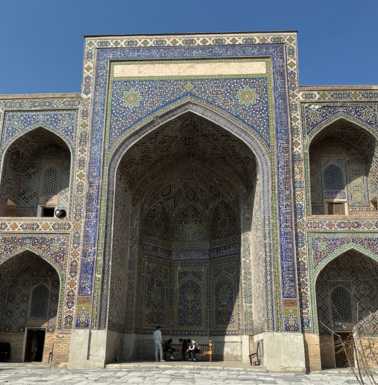
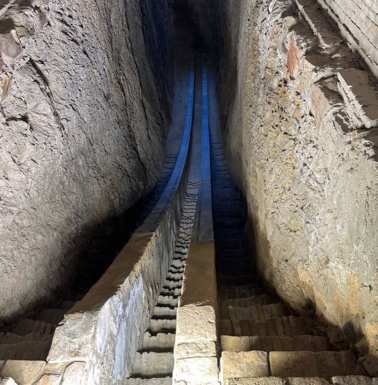
One favorite golden age example: Ulugh Beg. He ruled the empire and was also a scientist and promoter of learning. He founded and built one of the most beautiful madrasas, or schools, in Samarkand; and he built a three-story observatory with an enormous “sextant” that he used for measuring the elevation of major heavenly bodies. His star tables made in the 15th century are extraordinary in their accuracy.
Inner courtyard (and summer classroom) at Ulugh Beg's madrasa, Samarkand
Remains of Ulugh Beg's huge "sextant"
A quick word about the beautiful buildings
Decorating with bricks
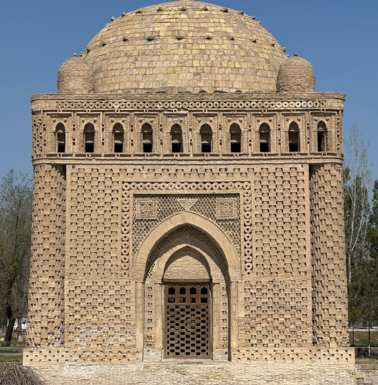
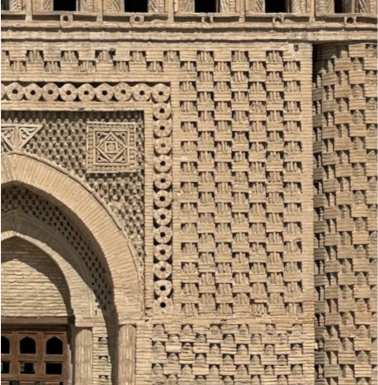
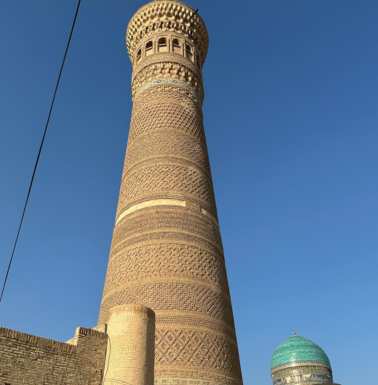
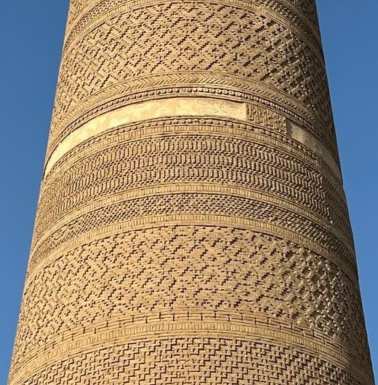
Before kiln-dried bricks (baked bricks) there was adobe and sun-dried brick. The magnificent sun-dried brick buildings described in ancient manuscripts eroded from wind and rain long ago (although you can see impressive ruins). But next came baked brick, which can be exposed to the elements, and allowed creating spectacular ornamental patterns. The 10th century Ismail Samani mausoleum and the 12th century Kalyan minaret, both in Bukhara, are beautiful examples of decorative brickwork.
10th century Ismail Samani mausoleum
10th century Ismail Samani mausoleum detail
12th century Kalyan minaret, Bukhara
12th century Kalon minaret, Bukhara, detail
Ceramics and the “bejeweled” buildings
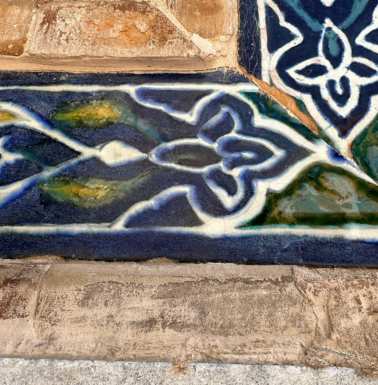
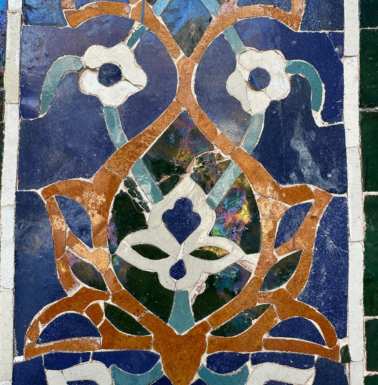
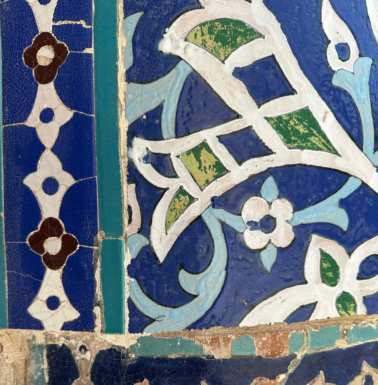
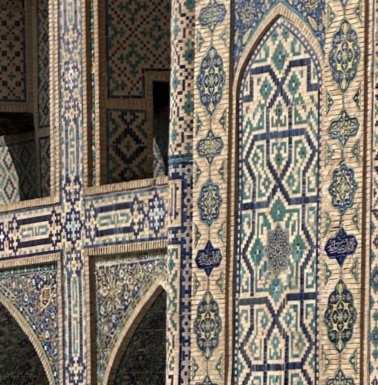
Speaking generally, the ceramic arts that we see on the beautiful buildings today were 14th and 15th century developments, as decorative style followed along with the developments in ceramics. You’ll see some of the most spectacular buildings in Samarkand, so here’s just a taste of ceramic decorations from there. There are three main methods: mosaics, majolica, and glazed bricks. Here are some examples.
There’s more about the beautiful buildings in my upcoming Fergana to Khiva post!
Majolica
Mosaics
Mosaic with glazed brick trim
Glazed bricks
How I got to Uzbekistan and who else was there
Do an internet search for Uzbekistan travel and you’ll find agencies and tours to meet every travel style – group or private, hiking, nature, hotels, yurts, pretty much whatever interests you. Or go solo.
My trip from the US to Tashkent was long, but I traveled via my old home airport (Philadelphia) and another favorite, Hamad International in Doha, so as I told people, the trip was long, but easy.
Tourism numbers from 2023 show that most tourists came from neighboring countries. After that, apparently in order, came tourists from Türkiye, South Korea (for historical reasons, Uzbekistan has a large population with Korean roots), Germany, US, France, and UK. The average tourist is between 31 and 55 years old.
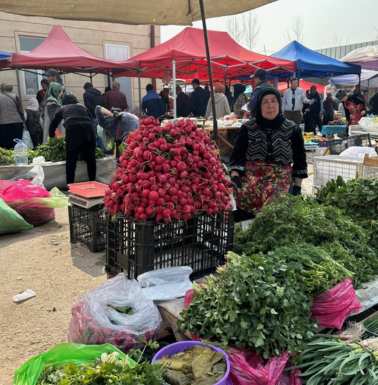
Kumtepa Bazaar near Margilan, Fergana Region.
My visit started at the beginning of the spring tourist season in early March. There were already many Russian tour groups; a big Italian group stayed at my hotel in Samarkand; in Bukhara, I met a small group of French friends traveling together; and here and there, Chinese groups. The big spring festival and national holiday Nowruz was celebrated on 21 March, the first day of spring, so Uzbek people were also traveling locally on the holiday weekend. Generally, though, there weren’t big crowds.
There’s a fall tourist season, too, but summer’s way too hot, and tourists usually stay away. One of my drivers said I should return in the fall when all the fruits are ripe. Uzbekistan has a wide variety of fruits and vegetables notwithstanding all the blog warnings I read about having no vegetarian restaurant options and expecting a daily diet of plov, the rice-based national dish.
Food
Having mentioned the region’s produce and abundant fruit orchards, I should mention eating. I say (too often?) that I’m not a foodie, and that I’m fond of buying packaged things at supermarkets. But “grocery shopping” in Uzbekistan is more a matter of going to a bazaar, or the occasional mini market. Goodbye packaged salads.
I made do with bread and fruit from a bazaar on my first day in Tashkent. Then, I started meeting up with my guides and found that most were fasting for Ramadan. While they always suggested taking me to a café for lunch, I declined and waited for dinner, after asking guides for restaurant recommendations. From then on, I feasted at breakfast, kept water, nuts and dried fruit handy for a snack, and had an early dinner on my own. It was easy to find restaurants, and there were also fast-food places. One of my favorites was an Uzbek fast food, tandir-cooked somsas (or samsas). And there was always fabulous bread.
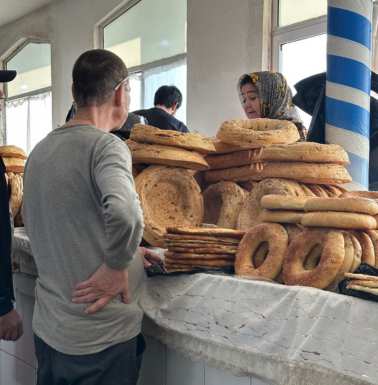
Each region has its own bread, This is Tashkent.
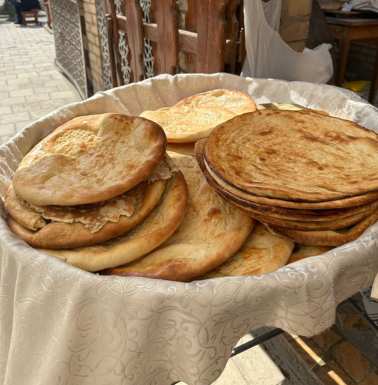
Khiva bread is flat - this was just baked.
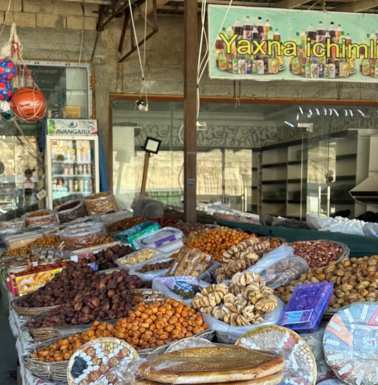
Only one row of the fruit, nuts, and produce at this roadside market outside Tashkent.
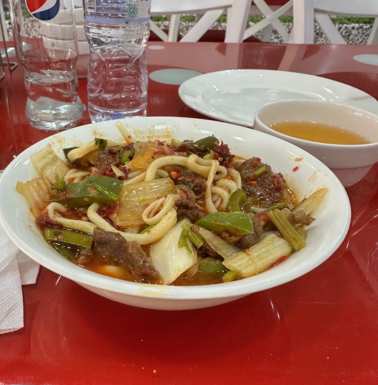
The famous Lagman at family style Anor restaurant.
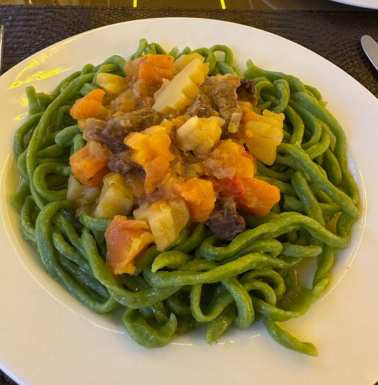
Shivit Oshi, special dill infused noodles unique to Khiva.
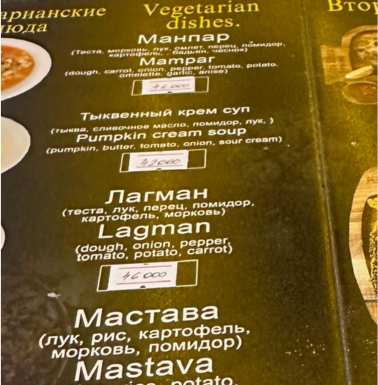
A random menu page showing vegetarian options (it's easy to transform some dishes, but ask for details). Dough means noodles.
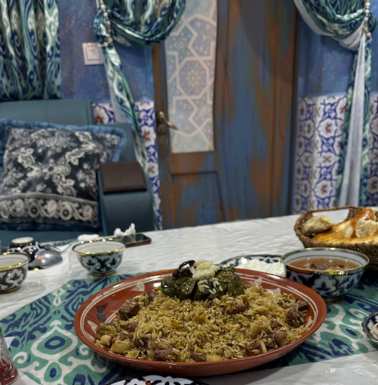
A platter of Fergana plov at a Chaikhana (tea house or casual restaurant). My guide, driver, and I shared.
More than one blog warned that you’d eat a lot of “greasy plov,” and that vegetarians and especially vegans were out of luck. Well, I happily had plov once (each region has its version) and always found salads on menus (I was fond of “beetroot” salad), though I don’t know that they were suitable for vegans. And ask about how dishes are vegetarianized – for example, was a dish cooked without meat, or was meat just removed after cooking? Also, remember that I was in cities – trekking in the countryside may indeed mean a lot of plov.
How I got around
I like DIY travel and get around well on my own, but I would need cars or taxis, and although I remember some Russian, it’s not enough. So, because I prefer traveling alone or with a travel-savvy friend, I decided on a solo trip that would provide an English-speaking guide and a driver in each city I visited. Additionally, I like to work regionally, so decided to work with a travel arranger in Kazakhstan that offered guided itineraries of varying lengths for private visitors.
The final itinerary gave me a different driver and guide in each city, and onward transportation tickets to the next place, but I traveled alone between cities (except Bukhara-Khiva which was a car trip) and had plenty of free exploring time everywhere. I was also on my own for meals.
This turned out well. Each of my guides was well-trained, deeply knowledgeable, and affable – I felt like I had friends (I also had their contact information). I needed English, and their English was strong. The drivers also saved me a lot of trouble, as I avoided having to figure out the local taxi culture first thing and was able to walk confidently through the phalanx of taxi drivers that greeted each plane and train. My drivers proved to be 100% reliable – never a missed meet-up and always on time.
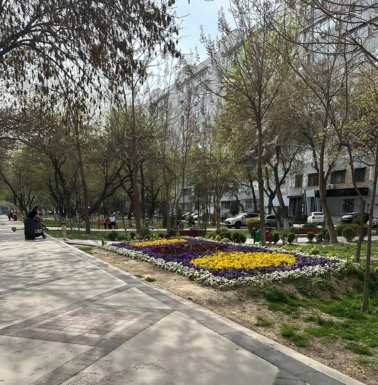
My Tashkent neighborhood was nicely walkable.
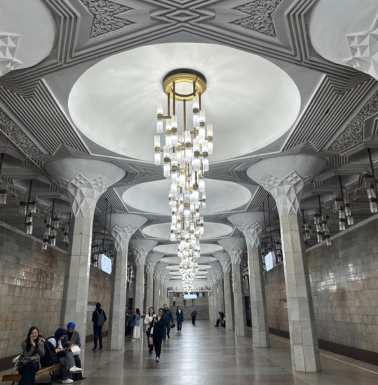
One of Tashkent's pretty metro stations; the metro makes getting around easier.
Language
The main languages of Uzbekistan are Uzbek (the official language) and Russian (from the imperial Russian occupation and the long Soviet period after 1924). Other languages such as Tajik are also spoken. In any case, if you’re comfortable traveling without knowing local languages, you know how to get along. There are guides available who speak a variety of languages, although as one told me, if there’s too much demand for certain languages during the high season, you might have to make do with English. So, if you can use English, you’re in luck. There are good English-speaking guides, and most hospitality sector employees speak enough English to do their jobs well. But don’t expect to find English (or French) speakers on every street; I found Russian most useful. Thank goodness for what I did remember. Plus, the Uzbek expressions I learned (on YouTube) surprised people and were appreciated.
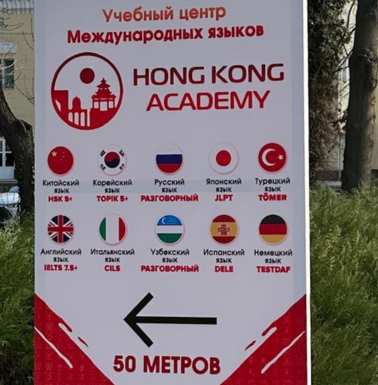
Language training on offer! No French at this school, but there's an Alliance Française in Tashkent.
Where I Went
As in a lot of countries, there’s a “golden trail” for first-time tourists. I followed the Uzbekistan version that goes to most Uzbek “Silk Road” cities. After landing in Tashkent and having a day on my own to get my bearings, I went by train to the Fergana Valley for a couple of days. (This wasn’t by the fast train but an old probably Soviet era train that took a long time. Take the trip over the mountains and you’ll understand why it’s slow.) But to continue, from Fergana, it was back to Tashkent, then to Samarkand by fast train (Spanish Talgo trains); from there a fast train to Bukhara; and then to Khiva via a six-hour ride with a driver whose English was no better than my Russian, but we communicated well. After Khiva and a driving trip to the Karakalpak region with my local guide, I flew from nearby Urgench back to Tashkent for the trip home.
A few things to keep in mind
Here are some things a travel or tour arranger can help with, but I was still caught short by one (re my cell phone).
First, of course check visa requirements. You might be exempt. I was, but out of caution, I applied anyway. It’s an e-visa, which I’ve gotten for other countries, and this was not very different, except for trouble with my photo. After failing more than once to insert a compliant photo, I did a search on the topic and found an old but helpful post that specified pixel sizes. Or try a photo shop, said one person I met.
And there were some formalities that I was prepared for, but which have apparently been rescinded; still, be attentive to anything that might relate to customs requirements.
But I wasn’t prepared for the requirement to register the IMEI codes of mobile devices – maybe. So, I approached a woman at an IMEI booth, who advised me, but as her advice was applicable to my specific situation and the duration of my trip, I’m not sharing it; and I won’t try to explain IMEI registration because I can’t. Just ask your travel adviser or do some research.